

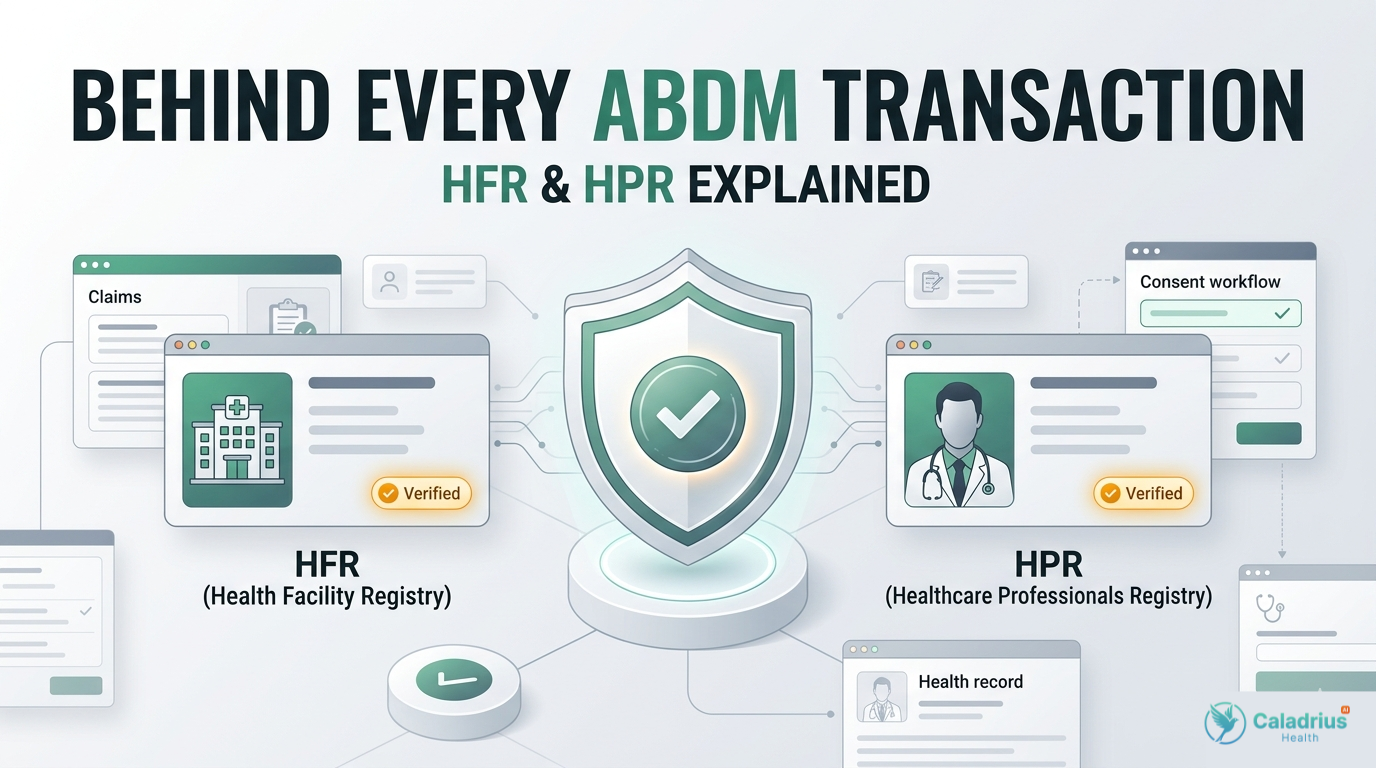
Every consent flow, every insurance claim, every digital health record exchange in India’s ABDM ecosystem depends on two registries. Most hospitals encounter them only during onboarding, but their role in every downstream transaction runs far deeper than that.
Article 2 of this series established how patients enter India’s digital health ecosystem, through the Ayushman Bharat Health Account (ABHA), their portable identity across every ABDM interaction. This article examines the other side of the same handshake: how facilities and professionals are verified before any interaction with a patient’s record can take place.
When a patient’s health record moves between a hospital and an insurer on the National Health Claims Exchange (NHCX), Ayushman Bharat Digital Mission’s (ABDM’s) interoperability platform for health insurance claims, two silent questions are answered before the data travels a single byte: Is this facility authorised to participate in this ecosystem? And: Is the professional who generated this record credentialled to practice?
The answers come from two national registries: the Health Facility Registry (HFR) and the Healthcare Professionals Registry (HPR). Neither registry generates headlines. Both sit beneath every downstream digital health interaction India’s ecosystem supports consent flows, claims routing, and health record exchange. This article explains what they are, what registration actually requires, and why it matters more operationally than most teams expect when they first encounter it.
What HFR and HPR Actually Are
The Health Facility Registry (HFR) is a national repository of health facilities across all systems of medicine, covering modern, Ayurvedic, Unani, Siddha, and Homeopathic practice. It includes hospitals, clinics, diagnostic laboratories, imaging centres, and pharmacies, whether public or private [1]. The Healthcare Professionals Registry (HPR) is the corresponding repository for practitioners: doctors, dentists, nurses, and an expanding set of allied health professionals who deliver care across those same systems [2].
Both registries are maintained by the National Health Authority (NHA), the apex body governing ABDM and Ayushman Bharat Pradhan Mantri Jan Arogya Yojana (PM-JAY). Together they serve a shared purpose: ensuring that only verified, authorised entities participate in India’s digital health ecosystem [2].
As per NHA’s PIB update dated 5 August 2025, 4,18,964 health facilities had registered on HFR and 6,79,692 healthcare professionals had registered on HPR. For context, 79.91 crore ABHA registrations existed alongside these figures — the patient identity layer this series examined in Article 2 [3]. The patient registry receives the bulk of public attention; the provider registries are what give that attention infrastructure to stand on.
The Architecture of Trust
Understanding why HFR and HPR matter requires understanding what ABDM is trying to accomplish structurally. ABDM follows a federated health data architecture: patient data stays at the source, within the facility’s Hospital Management Information System (HMIS) or Laboratory Management Information System (LMIS), and travels only with the patient’s explicit consent in HL7 FHIR format [4]. No central database holds everyone’s records.
For this architecture to work, every entity in the network must be identifiable and verifiable. When a patient consents to share records from Hospital A with Hospital B, the system must confirm that both are legitimate ABDM participants. When NHCX routes a claim from a provider to an insurer, the exchange must authenticate the submitting facility and the professional whose clinical work underlies that claim.
Per MoHFW’s Lok Sabha written reply of 6 December 2024, “ABDM comprises of key registries… such as Ayushman Bharat Health Account (ABHA), Healthcare Professional Registry (HPR), Health Facility Registry (HFR), and drug registry” — establishing HPR and HFR as structural components of the mission, not optional additions [3].
This structural role becomes most visible in claims processing. NHA’s National Health Claims Exchange (NHCX) automates the exchange of claims information among payers, providers, and beneficiaries through an open, interoperable protocol [5]. Because NHCX operates within the ABDM ecosystem, every transaction is anchored to the registry layer: a facility without a verified HFR entry and a professional without an active HP ID cannot be authenticated within the network. HFR and HPR are gateway conditions for live claims participation, not post-integration formalities.
The financial dependency is equally direct. The Digital Health Incentive Scheme (DHIS), launched on 1 January 2023 with an initial government outlay of Rs. 50 crore for its first six months, offers incentives of up to Rs. 4 crore per entity for generating ABHA-linked digital health records, but exclusively to facilities already registered on HFR [6]. By August 2023, 1,205 health facilities had registered under DHIS — 567 public and 638 private — reflecting the direct link between HFR completion and incentive access [7].
The dependency chain now extends well beyond ABDM-specific programmes. PM-JAY’s Hospital Engagement Module (HEM) requires facilities to enter their HFR ID before empanelment can proceed [8]. Under CGHS Office Memorandum F.No.5-34/CGHS/HEC(HQ)/2025 dated 22 December 2025, HFR registration became a mandatory prerequisite for the digital CGHS fresh empanelment process through the HEM portal [16]. All existing empanelled Health Care Organizations were required to submit fresh applications and updated Memoranda of Agreement by 31 March 2026, with automatic de-empanelment taking effect on 1 April 2026 for non-compliant facilities [16].
The National Medical Commission (NMC) has added a further dimension. Under Circular No. N-16021/2/2026-IT-NMC, signed by NMC Secretary Dr. Raghav Langer, all medical colleges and associated institutions were directed to verify their HFR IDs via the NMC portal and submit remaining IDs along with HMIS linkage details within seven days. The circular requires even nil inputs to be submitted with remarks, making this a mandatory compliance record rather than a conditional task [9]. HFR registration is no longer a parallel ABDM onboarding step; it is embedded in accreditation, empanelment, and scheme-access workflows.
Note: All workflows involving Aadhaar-based authentication, including HFR and HPR registration, are subject to prevailing identity and data privacy regulations, including the Digital Personal Data Protection Act, 2023. Facility teams should follow NHA’s published guidance and UIDAI directives for compliant implementation.
What Registration Actually Involves
For compliance and HR teams preparing for registration, the operational details matter.
Health Facility Registry (HFR)
HFR registration is managed at facility.abdm.gov.in. Facilities that already appear in the National Health Resource Repository (NHRR), a pre-existing government database of healthcare facilities, can benefit from pre-filled data fields. NHA uses NHRR data to reduce re-entry effort for eligible facilities [1].
Critical sequencing note: The administrator completing HFR registration must first hold a valid Healthcare Professional ID (HP ID) obtained through HPR. HFR facility creation requires HPR login credentials; attempting to create a facility record without an HP ID will stop the process at the first step [10].
For facilities not in NHRR, the process involves:
- Initiating registration using an Aadhaar-linked mobile number or HP ID.
- Locating the facility on the platform’s map interface using a pincode.
- Filling the registration form with details on facility type, category, sub-category, services offered, and infrastructure.
- Submitting for State/District Admin verification. The facility does not become active in the ABDM ecosystem until a designated State or District Health Officer approves the submission [11]. NHA indicates the end-to-end process takes approximately 20–30 minutes, provided all required documents are available at the time of submission: facility registration numbers, service classifications, and infrastructure details [1].
- Receiving the HFR ID — the facility’s unique identifier used across ABDM transactions — along with login credentials for the facility profile.
Data accuracy at the registration form stage is worth paying particular attention to. It is the most common reason State-level verification stalls.
Healthcare Professionals Registry (HPR)
HPR registration is managed at hpr.abdm.gov.in. Applications are council-verified, not self-certified. For doctors, verification is handled by State Medical Councils under bodies such as the National Medical Commission, the Dental Council of India, the National Commission for Indian System of Medicine, and the National Commission for Homeopathy; for nurses, it runs through the Indian Nursing Council and state equivalents [12].
The registration process requires the professional to select their category from a dropdown — a step worth double-checking, since a category selected in error must be corrected before submission [12]. They then add their council credentials, authenticate via Aadhaar or Driving Licence, and upload their State Medical Registration certificate and degree certificates. On successful council verification, the professional receives their HP ID: a 14-digit unique identifier also expressed as yourname@hpr.abdm [2].
The HP ID is the professional’s primary digital identity within the ecosystem: it surfaces in Unified Health Interface (UHI) appointment systems, underpins telemedicine credentials, and authorises the professional to generate ABDM-linked clinical records [2][4].
NHA has progressively expanded HPR coverage. The nurse module was rolled out nationally in 2022 following the initial launch of the doctor module [13]. Paramedicals, Accredited Social Health Activists (ASHAs), allied healthcare professionals, and community health workers are planned additions [13].
For Health IT Teams: Registering via the ABDM APIs
For hospitals integrating their HMIS directly with ABDM, both registrations can be completed programmatically through NHA’s published APIs rather than through the web portals. The sequence mirrors the manual process exactly — and the same sequencing constraint applies: the Healthcare Professional ID must be created first, before a facility record can be submitted.
The three-step flow for developers:
Step 1 — Authenticate. Every API call requires a session token obtained from https://dev.abdm.gov.in/gateway/v0.5/sessions using the clientId and clientSecret issued at sandbox sign-up. This token is passed as a Bearer header on all subsequent requests.
Step 2 — Create the HP ID (HPR). Using the HPR API base (hpridsbx.abdm.gov.in for sandbox), the flow runs: fetch the public encryption certificate → generate and verify an Aadhaar OTP → verify the contact mobile → check username availability → submit via POST /v1/registration/aadhaar/createHprIdWithPreVerified with council registration details. The response returns the 14-digit HP ID and the name@hpr.abdm address.
Step 3 — Register the Facility (HFR). The facility manager authenticates using the HP ID at the HFR API base (facilitysbx.abdm.gov.in for sandbox). The registration then moves through three sequential POST calls — basic information, additional information, and detailed information — before a final submit call places the record in Pending Verification status. The HFR ID is returned once a State or District officer approves the submission.
The most common integration errors at the API layer mirror those in the portal flow: submitting facility registration without a valid HP ID token, and selecting incorrect master data codes for ownership type or facility category. Both stop the process before submission reaches the verification queue. NHA’s Swagger documentation at facility.abdm.gov.in/swagger-ui.html and the HPR API reference at hpr.abdm.gov.in/apidocuments carry the current field definitions; endpoint paths are versioned and updated periodically.
For a complete API call reference — endpoints, request payloads, and response fields for every step — see the addendum at the end of this article: HFR & HPR Registration — The APIs to Follow.
Where Data Quality Gaps Emerge
The registries deliver on their purpose when the data within them is accurate, complete, and kept current. Gaps arise when registration is approached as a one-time checkbox rather than an operational foundation.
A peer-reviewed assessment of ABDM published in Health Systems & Reform (2024) found that inter-state variation in HFR and HPR registration progress is significant. The study used ABDM dashboard data as of June 2023, at which point over 208,000 HFR registrations and 190,000 HPR registrations had been verified, and noted that the pace of registration varied substantially across states [14]. The authors attributed this to the federal structure of health governance and varying capacity at the state level, recommending enhanced NHA engagement with states where registrations were progressing at slower paces, alongside training for state-level health functionaries and data managers [14].
NHA responded to this variation structurally. In August 2022, it announced performance-based fund allocation, tying Rs. 100 crore — 20% of the total Rs. 500 crore five-year state implementation budget — directly to verified HFR and HPR entries rather than distributing them uniformly [15]. The per-entry rates were specific: Rs. 100 for each verified entry completed on or before 31 December 2022, reducing to Rs. 50 for entries completed between 1 January 2023 and 31 March 2023, with no further allocation after that date [15]. States were free to deploy these funds toward dedicated human resources, full-time or part-time, assigned to ABDM data work — directly linking data quality to staffing decisions at the state level [15].
By November 2024, NHA’s microsite initiative, which provides targeted onboarding support in specific geographies, had 121 active microsites that registered over 48,000 facilities and linked 32 lakh ABHA health records [3]. The Scan and Share QR-based OPD service was operating across 17,481 facilities in 35 states and union territories, generating 6.64 crore tokens and reducing patient registration queue times from 30–40 minutes to 5–10 minutes [3]. Both services require a verified HFR registration as a prerequisite; a facility without an active HFR profile cannot generate Scan and Share tokens or participate in ABDM-linked OPD workflows.
For individual hospitals and health systems, the most common registration gaps fall into four areas. Facility type and service classification mismatches are the most frequent — selecting the wrong category affects scheme eligibility and discoverability on the national platform. Outdated infrastructure data is a close second; services that change post-registration must be updated in the facility profile, since the registry is a live operational record. For HPR, council verification delays are common when applications carry incomplete council registration details, leaving professionals without active HP IDs for extended periods. The most avoidable issue is sequencing: attempting HFR facility creation without a valid HP ID stops the process before it begins [10].
What Comes Next for These Registries
Three developments warrant close attention before Article 4 examines how data flows through this infrastructure.
The first is the HPR category expansion. NHA has confirmed that paramedicals, ASHAs, and allied health professionals will be added to the registry [13]. For hospital HR and credentialing teams, the population of staff requiring HP IDs will grow substantially. Structuring a scalable onboarding process for current categories now makes that expansion considerably more manageable.
The second is the deepening integration of HFR and HPR into institutional accountability frameworks. The NMC’s direction requiring medical colleges to verify and submit HFR IDs as part of annual renewal [9], combined with the CGHS requirement that all empanelled HCOs complete HFR registration before accessing the HEM portal [16], signals a broader shift: registry completeness is becoming a condition of scheme participation, not an optional feature of digital health readiness.
The third development affects facilities integrating their HMIS with ABDM production infrastructure. The sandbox-to-production transition for HMIS software requires a “Safe-to-Host” certificate issued by a CERT-IN empanelled security auditor, confirming that the application meets ABDM’s Health Data Management Policy requirements for secure data handling and consent logging [17]. Facilities coordinating this integration should build the certification lead time — typically four to eight weeks — into their project plans.
Conclusion
HFR and HPR are not the most visible components of India’s digital health architecture, but they are among the most consequential. Every ABDM-linked health record exchange, every NHCX claim route, every DHIS incentive access point, and every PM-JAY empanelment depends on registry data being present, accurate, and verified. Treating registration as a background administrative step — complete once, revisit never — creates operational exposure that surfaces at precisely the wrong moment in an integration cycle.
The compliance and credentialing teams reading this article are well-placed to change that. The process is well-documented and the timelines are manageable. What changes when it is done well is not just compliance status — it is the operational foundation on which Article 4’s subject, the actual flow of health data through the ABDM ecosystem, depends.
Next in this series: Article 4 examines how health data actually flows through the ABDM ecosystem: the consent manager layer, Personal Health Records (PHR), and what it means operationally for hospitals to register as Health Information Providers (HIPs).
CaladriusHealth.AI covers India’s health technology landscape with a focus on ABDM, NHCX, medical billing, and AI in healthcare. This article is part of a series on India’s digital health infrastructure.
Prefer watching over reading?
Watch a short explainer on the HFR and HPR, the two registries that give every hospital and clinician a verified digital identity, and see why no ABDM claim, DHIS incentive, or PM-JAY empanelment works without them.
Sources Referenced in This Article
All sources are publicly verifiable. Government and peer-reviewed sources are preferred; secondary sources are explicitly labelled as such.
[1] — Government Source (Primary) National Health Authority — Health Facility Registry (HFR) portal. Covers facility type scope, NHRR pre-fill process, and registration overview, including the ~20–30 minute timeline guidance.
- Main portal: https://facility.abdm.gov.in/
- NHRR onboarding page: https://facility.abdm.gov.in/nhrr
[2] — Government Source (Primary) National Health Authority — Healthcare Professionals Registry (HPR) portal. Covers HPR purpose, council certification requirement, registration steps, and HP ID format. https://hpr.abdm.gov.in/en
[3] — Government Source (Primary) Press Information Bureau / MoHFW — Update on Ayushman Bharat Digital Mission, 5 August 2025. Contains most recent verified registry statistics: HFR (4,18,964), HPR (6,79,692), ABHA (79.91 crore). https://www.pib.gov.in/PressReleasePage.aspx?PRID=2155449
Secondary reference: Press Information Bureau / MoHFW — Update on Ayushman Bharat Digital Mission, 27 November 2024. Contains earlier registry statistics: HFR (3,49,473), HPR (5,23,639), ABHA (68.97 crore); also contains Scan and Share (17,481 facilities; 6.64 crore tokens) and microsite (121 microsites; 48,000+ facilities) figures cited elsewhere in this article. https://www.pib.gov.in/PressReleasePage.aspx?PRID=2081482
[4] — Government / DPI Source DPI Global — ABDM architecture overview. Describes federated health data model, HL7 FHIR format, consent manager, and ABDM building blocks including HFR, HPR, UHI, and NHCX. https://www.dpi.global/globaldpi/abdm
[5] — Government-Adjacent Technical Standard (Primary) NRCeS / NHA — FHIR Implementation Guide for ABDM, NHCX Profiles (v3.0.1). Published by the National Resource Centre for EHR Standards (NRCeS), the body responsible for ABDM technical standards under NHA. States verbatim: “NHA has created a standardized health claim platform based on the Health Claim Exchange Specification (NHCX) to enable automation of the health claim-related information exchange between payers, providers, beneficiaries, and other relevant entities.” Describes NHCX as interoperable, machine-readable, auditable, and open standards-based. Publicly accessible, no login required. https://nrces.in/ndhm/fhir/r4/3.0.1/hcx-profile.html
[6] — Government Source (Primary) Press Information Bureau — NHA announces DHIS launch, December 2022. Rs. 50 crore initial outlay; six-month scheme from 1 January 2023; HFR registration confirmed as eligibility prerequisite; incentives up to Rs. 4 crore per entity. https://www.pib.gov.in/PressReleasePage.aspx?PRID=1885610
[7] — Government Source (Primary) Press Information Bureau — NHA announces extension of DHIS to 31 December 2023, August 2023. As of August 2023: 1,205 facilities registered (567 public, 638 private); scheme extended for continued impact. https://www.pib.gov.in/PressReleaseIframePage.aspx?PRID=1945911
[8] — Government Source Kerala State Health Authority — PM-JAY 2.0 Hospital Engagement Module (HEM) User Manual, Version 1.0, November 2024. Documents HFR ID as mandatory input for PM-JAY empanelment process. https://sha.kerala.gov.in/wp-content/uploads/2024/12/PMJAY2.0-HEM-User-Manual_V1.0-1-2.pdf
[9] — Government / Regulatory Source (Primary) National Medical Commission — Circular No. N-16021/2/2026-IT-NMC, signed by NMC Secretary Dr. Raghav Langer, February 2026. Directs all medical colleges and institutions to log in via the NMC portal (nmc.org.in), verify HFR IDs held in NMC records, and submit remaining HFR IDs plus HMIS linkage status with PM-JAY and ABDM-HMIS portals of NHA. Verbatim from the circular: “The above details are to be submitted via the college login on NMC website (nmc.org.in) within 7 days of this notice. Even nil inputs are also to be submitted with remarks within prescribed schedule.” Primary document hosted on nmc.org.in. https://www.nmc.org.in/MCIRest/open/getDocument?path=%2FDocuments%2FPublic%2FPortal%2FLatestNews%2Fdocument+%285%29.pdf
[10] — Industry Source (Secondary) NICEHMS Blog — HPR and HFR registration guide, including sequencing dependency (HP ID required before HFR facility creation), December 2023. https://www.nicehms.com/blog/post/nhas-health-professional-registry-hpr-and-health-facility-registry-hfr
[11] — Government / State Source Rajasthan Government Health Department — ABDM HFR Registration User Manual, May 2024. Documents State/District Admin verification step. https://rghs.rajasthan.gov.in/HFR_Creation.pdf
[12] — Government Source (Primary) National Health Authority — HPR FAQ page, official HPR portal. Lists council bodies responsible for verifying HPR enrolment, verbatim: “National Medical Commission (NMC), Dental Council of India (DCI), National Commission for Indian System of Medicine (NCISM), National Commission for Homeopathy (NCH), Indian Nursing Council (INC) are some of the bodies overseeing enrolment along with the respective State Councils/Registrars/Boards.” Also covers registration process, document requirements, and category selection guidance. https://hpr.abdm.gov.in/en/faq
[13] — Government Source (Primary) Press Information Bureau — NHA rolls out Nurse Module of Healthcare Professionals Registry under ABDM, April 2022. Confirms doctor module already active; nurse module national rollout; planned expansion to paramedicals, ASHAs, and allied health professionals. https://www.pib.gov.in/PressReleasePage.aspx?PRID=1820411
[14] — Academic / Peer-Reviewed Source Mishra et al. — “The Ayushman Bharat Digital Mission of India: An Assessment,” Health Systems & Reform, Vol. 10, No. 2 (2024). Received March 2024; accepted August 2024; published online 22 October 2024. ABDM dashboard data as of June 2023. Key findings: 208,000+ HFR and 190,000+ HPR registrations verified as of June 2023; significant inter-state variation in registration pace; capacity building and state-level NHA engagement recommended. https://www.tandfonline.com/doi/full/10.1080/23288604.2024.2392290
[15] — Government Source (Primary) Press Information Bureau — NHA announces performance-based fund allocation to States and UTs based on verified HFR and HPR data quality, August 2022. Rs. 100 crore of incentive funds linked to registry performance metrics. Per-entry rates: Rs. 100 per verified entry before 31 December 2022; Rs. 50 per verified entry between 1 January 2023 and 31 March 2023; nil thereafter. States may use funds for ABDM-dedicated human resources. https://www.pib.gov.in/PressReleaseIframePage.aspx?PRID=1852294
[16] — Government Source (Primary) NABH-QCI Notification dated 12 January 2026 — explicitly references MoHFW CGHS Office Memorandum F.No.5-34/CGHS/HEC(HQ)/2025 dated 22 December 2025, inviting fresh empanelment of private HCOs under CGHS. HFR registration is a mandatory prerequisite for the digital HEM portal application. All existing HCOs required to submit fresh MoAs by 31 March 2026; non-compliance results in automatic de-empanelment on 1 April 2026. Primary O.M. reference: https://nabh-portal-live.s3.ap-south-1.amazonaws.com/wp-content/uploads/2026/01/14102537/Notification-for-Processing-of-Applications-Received-on-or-after-22.12.2025-under-NABH-QCI-for-CGHS-Empanelm.pdf Supporting summary (secondary): https://www.govtemployeeshub.com/2025/12/cghs-fresh-empanelment-2025-guidelines.html
[17] — Technical / Process Source ABDM Sandbox-to-Production documentation — “Safe-to-Host” certificate requirement. HMIS applications seeking ABDM production credentials must obtain a Safe-to-Host certificate from a CERT-IN empanelled security auditor as part of the Web Application Security Audit (WASA) process. Multiple implementation guides confirm this as a non-negotiable exit requirement from the ABDM sandbox environment. Reference guides: https://nirmitee.io/blog/abdm-certification-process-sandbox-to-production-guide/ and https://bahmni.atlassian.net/wiki/spaces/BAH/pages/2981232664/FAQs%20on%20ABDM%20and%20Bahmni%20compliance
Addendum: HFR & HPR Registration — The APIs to Follow
This is the full list of ABDM/NHA API calls a person needs to follow, in order, to create a
Healthcare Professional ID (HP ID / HPR) and a Health Facility ID (HFR ID).
Each row says what the call does, the method, the endpoint, what you send, and what you get back.
Exact paths/field names should be confirmed against the official docs linked at the bottom — the
registries are versioned (/v1, /v1.5) and change occasionally.
Part 1 — Log in once (authentication)
| # | What it does | Method & Endpoint | You send | You get back |
|---|---|---|---|---|
| 1 | Get an access token (needed on every later call) | POSThttps://dev.abdm.gov.in/gateway/v0.5/sessions |
Your clientId + clientSecret (from the ABDM sandbox signup) |
A JWT accessToken |
On every following call, add two headers:
Authorization: Bearer <accessToken> and
X-CM-ID: sbx (sandbox) / abdm (production).
Part 2 — Create the HP ID (Professional / HPR)
Base URL — sandbox: https://hpridsbx.abdm.gov.in · production: https://hpr.abdm.gov.in
| # | What it does | Method & Endpoint (confirm in docs) | You send | You get back |
|---|---|---|---|---|
| 1 | Get the public key / certificate used to encrypt Aadhaar & OTP | GET/api/v1/auth/cert | — | Public key |
| 2 | Send OTP to the Aadhaar-linked mobile | POST/v1/registration/aadhaar/generateOtp | Encrypted Aadhaar number | txnId (OTP goes to phone) |
| 3 | Verify the Aadhaar OTP | POST/v1/registration/aadhaar/verifyOTP | txnId + encrypted OTP | Aadhaar demographics + txnId |
| 4 | Send OTP to the contact mobile number (if different) | POST/v1/registration/aadhaar/generateMobileOTP | txnId + mobile no. | OTP sent |
| 5 | Verify the mobile OTP | POST/v1/registration/aadhaar/verifyMobileOTP | txnId + OTP | Mobile confirmed |
| 6 | Check whether a desired username is available | POST/v1/hpId/exist | Desired username@hpr.abdm | Available / taken |
| 7 | Get system-suggested usernames (if taken) | GET/v1/suggestion | txnId | List of suggestions |
| 8 | Create the HP ID + set password + add council details | POST/v1/registration/aadhaar/createHprIdWithPreVerified | Username, password, demographics, council registration no., council, qualification/degree | The 14-digit HP ID + name@hpr.abdm |
Returning user (already has an HP ID): skip Aadhaar — use
POST /v1/login/mobile/generateOtp → /v1/login/mobile/verifyOtp →
then check/fetch the existing HP ID.
Part 3 — Create the HFR ID (Facility)
Base URL — sandbox: https://facilitysbx.abdm.gov.in · production: https://facility.abdm.gov.in
Prerequisite: the Facility Manager must already have an HP ID from Part 2.
| # | What it does | Method & Endpoint (confirm in docs) | You send | You get back |
|---|---|---|---|---|
| 1 | Facility Manager logs in with the HP ID | POST/v1/auth/authPassword | HP ID + password | A token for the HFR calls below |
| 2 | Get the list of ownership types (dropdown values) | GET Master data, type=OWNER | — | Ownership codes |
| 3 | Get the systems of medicine (Allopathy, Ayurveda, etc.) | GET Master data, type=MEDICINE | — | Medicine-system codes |
| 4 | Get the valid facility types for that ownership + medicine | GET/v1/facility/facilityType | ownershipCode, systemOfMedicineCode | Facility-type codes |
| 5 | Check the facility is not already registered | POST/v1/facility/search | Facility name / details | Existing match (if any) |
| 6 | Submit Step 1: basic information | POST/v1.5/facility/basic-information | Name, ownership, type, region/address, pincode | A draft facilityId / reference |
| 7 | Submit Step 2: additional information | POST/v1.5/facility/additional-information | Services offered, timings, contact | Draft updated |
| 8 | Submit Step 3: detailed information | POST/v1.5/facility/detailed-information | Infrastructure, beds, registration numbers, uploads | Draft updated |
| 9 | Final submit — send for State/District verification | POST/v1.5/facility/submit | The completed facility draft | Status = Pending verification |
| 10 | Check status / collect the HFR ID once approved | GET/v1/facility/status | facilityId | Approved → the HFR ID (also your HIP ID) |
Where the official documentation lives
- HPR API documents:
https://hpr.abdm.gov.in/apidocuments - HFR live API list (Swagger):
https://facilitysbx.abdm.gov.in/swagger-ui.html(sandbox) ·https://facility.abdm.gov.in/swagger-ui.html(production) - "HFR Registration via APIs" guide (PDF):
https://sandbox.abdm.gov.in/static/media/HFR%20Registration%20APIs.b5be38c8.pdf - HPR / HFR sandbox overview:
https://sandbox.abdm.gov.in/docs/hpr·https://sandbox.abdm.gov.in/docs/hfr - Getting tokens & headers explained simply:
https://kiranma72.github.io/abdm-docs/1-basics/working_with_abdm_apis/ - Sign up for sandbox credentials:
https://sandbox.abdm.gov.in
Note: endpoint paths above are accurate to the current ABDM sandbox conventions but are not legally binding — always open the Swagger / HPR API docs above to confirm the exact path and request fields before building, since NHA updates these periodically.