

Previously in this series
In the first article, Meera discovered that leaving a hospital doesn’t have to mean leaving her health records behind. Curious whether there was a better way, she created her ABHA and linked the records she had. She wondered whether it would actually make any difference the next time she needed medical care.
A few weeks later, she found out.
A Routine Visit
Work had brought Meera back to Chennai for a few days, and before heading to the airport she stopped at a hospital for a routine thyroid follow-up. It wasn’t an emergency, just another appointment that had quietly become part of her life.
As she walked towards the registration counter, she instinctively reached for the familiar folder in her bag: old prescriptions, blood test reports, consultation notes collected from different hospitals over the years. Then she smiled. Most of them were already on her phone.
She still wasn’t sure whether that would change anything.
She Didn’t Have to Start From the Beginning
The receptionist looked up and asked if she had an ABHA. Meera nodded, and the receptionist asked Meera to scan a QR code that appeared on the registration screen. She scanned it, approved the request on her phone to share her ABHA information, and within moments her registration was complete.
No searching for an old hospital number. No writing the same personal details again. No wondering whether she had remembered to bring the right report.
It felt surprisingly ordinary. Only later did she realise how much time she hadn’t spent repeating herself.
New to ABHA? If you’re wondering what it is or how to create one, we’ve covered that in the first article of this series.
The Conversation Picked Up Where It Left Off
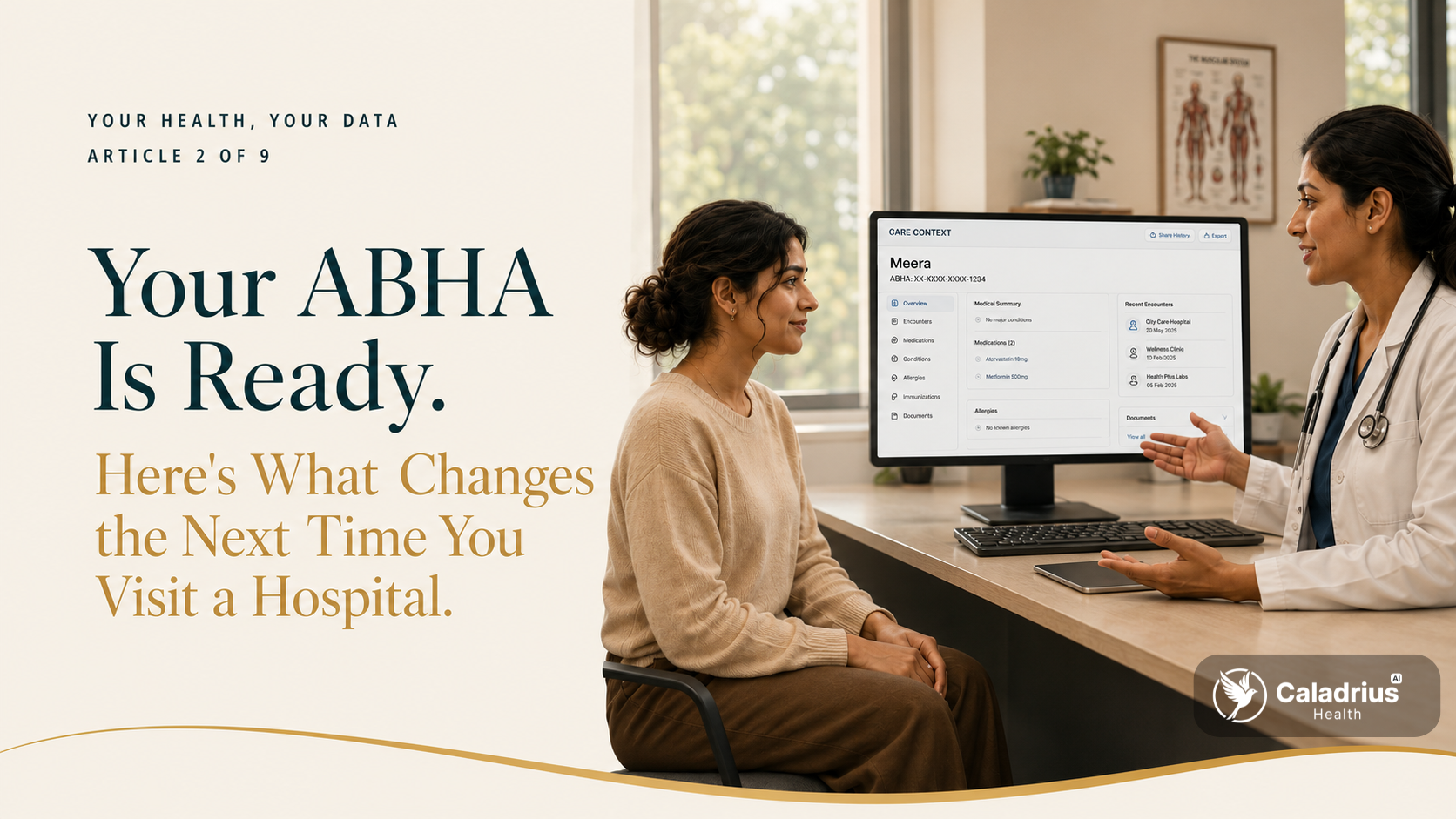
When the doctor opened her record, the appointment felt different. Instead of asking her to recall every medication she had taken or every test she had undergone, he already had enough context to continue the conversation.
“So… how have you been feeling since your last visit?”
It was a small difference, but to Meera it felt like someone had pressed resume instead of restart. She spent less time explaining her past and more time talking about how she felt today.
That was the real change. Not that the technology existed, but that it quietly stepped out of the way.
One Small Habit
After completing her visit with the doctor and collecting her prescription, Meera sat for a few minutes in the outpatient lobby before leaving. She opened her health app and found that today’s consultation had already appeared, along with the prescription.
As she scrolled through her records, she noticed something. Some of her older reports weren’t there: a blood test from before she moved, a dermatologist’s prescription from two years ago, a specialist’s handwritten advice she had photographed because the paper had begun to fade.
She spent a few minutes uploading them. Nobody had asked her to. She simply liked the idea that the next doctor she met wouldn’t have to piece together her medical history from memory.
Health histories aren’t built in one hospital. They’re built over years, one consultation, one report, one prescription at a time.
A Familiar Face in the Lobby
As she finished uploading the last report, someone called her name.
It was an old colleague she hadn’t seen in years. His father was scheduled for a planned procedure later that week, and the family had spent the morning moving between counters, gathering forms and instructions.
As they spoke, Meera realised that the family’s biggest questions were no longer about the surgery itself. The doctors had already explained that. What they were trying to understand was everything that came next. Would insurance approve it? Would they have to pay a large amount themselves? Would there be unexpected expenses?
Then her colleague mentioned something else. The admission desk had asked whether his father had an ABHA, and the family wasn’t sure what to say.
A few weeks ago, Meera wouldn’t have known either. Now she did.
She explained it the way she wished someone had explained it to her: a single health ID that lets your records travel with you, so that every hospital doesn’t have to start from a blank page. She showed him her own app, the consultation from an hour ago already sitting in her record. She told him how his father’s previous reports, the diagnosis, the specialist consultations, could be linked or uploaded before admission, so that when the hospital prepared its paperwork for the insurer, the supporting documents would already be in one place.
Her colleague listened the way she had once listened: half curious, half surprised that nobody had told him this earlier.
When the family headed towards the insurance desk, he asked Meera to come along. She clearly understood this better than they did.
At the Insurance Helpdesk
At the helpdesk, the counsellor walked the family through the admission process. Once the doctor finalised the treatment plan, the hospital would submit a pre-authorisation request to the insurer. The family would provide their policy details and complete the required formalities. If additional treatment became necessary later, the hospital would communicate with the insurer again.
When the family looked uncertain, Meera stepped in to simplify what they had just heard. Pre-authorisation, she explained, was the hospital seeking the insurer’s approval before treatment began. The documents the counsellor had listed, past reports, prescriptions, the diagnosis, were the same records that could already be linked to an ABHA account, ready when the hospital needed them, rather than gathered from different facilities in the days before surgery.
The counsellor could see she was familiar with the process. He confirmed what she had described and added the details only someone at that desk would know: the timelines, the forms, what the insurer typically asked for. Between the two of them, the family’s list of unknowns grew shorter.
The process sounded reassuring. But as Meera listened, she noticed something about its shape. Everything happened after the treatment plan was ready.
The Question That Stayed With Her
Because she now understood how the pieces fit together, Meera could also see the gap between them.
The hospital would submit the treatment plan. The insurer would review it. The approval would follow, based on the policy and the clinical details. All of it made sense. But one question remained.
Was there a way for families to understand, before any of that began, what their insurance was likely to cover and what they might still have to pay themselves?
She asked the counsellor directly.
The counsellor acknowledged that it was a question many families asked, and the right one to ask. But today’s process could only provide those answers after the treatment plan had been reviewed by the insurer.
Meera thanked him, wished her colleague’s family well, and walked towards the exit. The question stayed with her.
Before a planned procedure, families prepare for the treatment itself and for the costs that come with it. Under today’s process, the clinical questions are answered early, while the financial ones are answered only after the treatment plan reaches the insurer. Helping patients understand likely coverage and expected expenses before the formal approval process begins is the idea behind emerging approaches such as pre-determination. While still evolving, they aim to give patients and hospitals greater financial clarity earlier in the care journey.
As She Walked Away
By the time Meera stepped outside, the question she had walked in with, whether her ABHA would actually change anything, had been answered.
Her hospital visit had taken less effort than she expected. She hadn’t repeated her medical history or searched through a folder of papers. She had added another chapter to a health record that could continue growing with her. And for the first time, she had passed on what she had learned, watching a family’s uncertainty ease a little because someone in the room had been through it before.
As she reached the cab stand, her phone buzzed. A notification: her visit summary had been linked, and her prescription was already there.
She smiled, locked her phone, and slipped it back into her bag. The appointment was over. But her health history had travelled with her once again.
This is Article 2 in the “Your Health, Your Data” series from CaladriusHealth.AI, a nine-part guide to India’s digital health ecosystem. The series covers ABHA, health data consent, claims and cashless hospitalisation, switching hospitals, and the rights patients carry into every clinical encounter.
Prefer watching over reading?
Watch a quick recap of what changes at the hospital once your ABHA is linked, from registration to the insurance helpdesk.
Sources
All sources are from 2024–2026 and drawn from government, regulatory, peer-reviewed, and credible public-interest publications.
[1] Ayuapp / ABHA Health ID India: ABDM-compliant hospital and diagnostic networks as of 2026, including Apollo, Fortis, Manipal, Narayana, Max, Dr. Lal PathLabs, SRL, Thyrocare, among others. (Industry/Implementation) https://ayuapp.com/blog/abha-health-id-india
[2] CollegeSimplified: ABHA app Personal Health Record folder: scan and upload of old physical documents, categorised by date and doctor. (Industry) https://www.collegesimplified.in/post/beyond-the-paper-how-abha-id-is-rewriting-india-s-medical-history-in-2026
[3] National Health Authority: ABDM consent framework: time-bound, purpose-specific, revocable patient consent for every record access request within the network. (Primary, Govt) https://abdm.gov.in
[4] Sreepada SS: Bridging the digital divide: a longitudinal analysis of health equity in India’s Ayushman Bharat Digital Mission (2024–2025). International Journal of Community Medicine and Public Health, Vol. 13 No. 7 (2026). ABHA account coverage: 32.7% to 53.9% of population (Jan 2024–July 2025). (Peer-reviewed) https://www.ijcmph.com/index.php/ijcmph/article/view/15283
[5] BMC Health Services Research: Study of adoption rates of ABHA ID registration at three tertiary care hospitals in Agra compared to conventional OPD registration; examines digital health literacy levels and barriers to use. Cross-sectional study, 425 OPD attendees, Sept 2024–Apr 2025. (Peer-reviewed) https://pmc.ncbi.nlm.nih.gov/articles/PMC13078079/
[6] National Health Authority: ABDM FAQ: Scan and Share feature; demographic details shared via QR code scan for OPD registration with implied consent. (Primary, Govt) https://abdm.gov.in/faq/1000
[7] SBI General Insurance: Pre-authorisation in health insurance: required documents include test results, prescriptions, and past medical records supporting the diagnosis. (Industry, Insurer) https://www.sbigeneral.in/blog/health-insurance/health-articles/pre-authorisation-in-health-insurance
[8] NYVO Health Insurance Claims Guide: cashless claim settlement timeline 7 to 30 days post-discharge; document queries add 10 to 15 days; enhancement requests and denial workflow; reimbursement document requirements. (Industry/Claims advisory) https://nyvo.in/resources/claims/health-insurance-claims-guide
[9] Terra Insight / TransactIG: cashless claim reconciliation: co-pay, deductibles, and non-covered items collected at discharge; TPA processes final settlement within 15 to 30 days of final bill submission. (Industry/Finance operations) https://www.terra-insight.com/insights/cashless-claim-settlement-reconciliation/
[10] IRDAI.gov.in: IRDAI (Insurance Products) Regulations 2024 and Health Insurance Master Circular: maximum waiting period for pre-existing diseases capped at 36 months effective April 2024; cashless pre-authorization mandated within 1 hour; discharge authorization mandated within 3 hours. (Primary, Regulatory) https://irdai.gov.in/health-dept
[11] NYVO: Room Rent Limit in Health Insurance: room rent sub-limits and proportionate deductions explained. (Industry/Claims advisory, IRDAI-certified) https://nyvo.in/health-insurance/room-rent-limit
[12] NHA ABDM FHIR Implementation Guide: Health Information types defined under ABDM including OPConsultation, DiagnosticReport, Prescription, DischargeSummary, ImmunizationRecord, HealthDocumentRecord, and WellnessRecord; each type must be specifically requested and consented to. (Primary, Govt) https://nrces.in/ndhm/fhir/r4/index.html
[13] Nirmitee / NHA ABDM: ABDM integration milestone framework: M1 covers ABHA creation and patient identity; M2 covers health record linking as Health Information Provider; M3 covers health information exchange as both HIP and HIU. (Industry, referencing NHA official certification framework) https://nirmitee.io/blog/abdm-integration-milestones-m1-m2-m3-m4-multi-software-guide/
[14] SMC Insurance: Cataract surgery and health insurance in India 2026: pre-authorization required for planned cashless procedures, typically 24 to 72 hours before surgery; patient pays non-covered items at discharge. (Industry, Insurance advisory) https://www.smcinsurance.com/health-insurance/articles/does-health-insurance-cover-cataract-surgery-india
[15] NHA ABHA App (Google Play): patients can access and share prescriptions, lab reports, and discharge summaries through the ABHA app. (Primary, Govt) https://play.google.com/store/apps/details?id=in.ndhm.phr
[16] Healthcare With AI: when clinic management software is ABDM-ready and includes doctor’s HPR ID, patients with linked ABHA receive prescriptions in their PHR app automatically. (Industry/Implementation) https://healthcarewithai.cloud/blog/how-to-register-hpr-healthcare-professionals-registry-india