Caladrius Health AI Studio — Product brief

Revenue Intelligence for Hospitals. Built for National Digital Health Rails.

Caladrius Health AI Studio is an AI-native revenue intelligence application for hospitals in India, the Middle East and the USA. It brings augmented intelligence capabilities that enable persona-based, data-driven insights and verifiable, explainable AI workflows with in-built evals and benchmarks. It is cloud-agnostic — deliverable on-premise, in a private cloud, or in a public cloud.

It works the revenue cycle end to end — eligibility, pre-authorisation, claim submission, denial management, reconciliation — directly on ABDM and NHCX, the national digital health infrastructure Indian providers are already adopting. Not a dashboard over a manual process, and not a copilot bolted onto a legacy RCM suite: the workflow, the clinical data model and the AI were designed together.

Security by design, in the literal sense. The rules that protect patient data are encoded into how every line of code gets written, and enforced by tooling as it is written — not reviewed for afterwards. How that works

For providers evaluating what to run their revenue cycle on For partners evaluating what to build with us
ABDM NHCX FHIR R5 SNOMED CT · ICD-10 DPDPA 2023 WASA — in progress HIPAA-aligned ISO 27001-aligned On-premise · Private cloud · Public cloud

What AI-native means here

The model was designed into the workflow. Not sprinkled over it.

"AI-powered" is claimed by every vendor in this category, and it usually describes a chat box beside an unchanged process. Three things separate what we built, and each is verifiable in a demo rather than asserted in a deck.

Grounded in the record, not in the prompt

A claim bundle is assembled from the encounter that actually happened — the facility's real HFR identifier, an HPR-verified care team, coverage resolved by live policy discovery against the payer, conditions coded in SNOMED CT and translated to ICD-10 through the NRCeS Bharat Health Terminology Service, procedures typed as procedures rather than flattened into diagnoses.

Anti-hallucination is a property of the pipeline, not an instruction in the prompt. Where no confident code match exists, the field is left for a human rather than invented — and the assembled bundle is inspectable, resource by resource, before anything is submitted.

Standards are the substrate, not an export format

The data layer is medical infrastructure in its own right — modelled natively on FHIR R5 and the ABDM Patient Profile rather than a proprietary schema with a translation layer bolted to the edge. Claims move as NHCX ClaimBundles. Records move under ABDM consent artefacts.

The practical consequence: when the national rails change, we change a mapping — not a data model. And a provider's data stays portable to anything else that speaks the same standards.

Explainable because it is traceable

Every record carries provenance. A visit pulled from another hospital is labelled as theirs; a record we published that comes back through ABDM is recognised as ours and de-duplicated, never double-counted or claimed against twice.

When a payer denies or queries a submission, the resubmission is resolved against the actual denial code and the specific document requested — it answers that question, rather than resubmitting the same bundle and hoping.

And because AI output in a regulated setting has to be measurable, not merely plausible, model behaviour is held to in-built evals and benchmarks rather than to impressions — so a change in accuracy shows up as a number before it shows up as a denial.

The platform

What is running today.

One workspace across identity, clinical records, claims and money. Each capability below is built, tested and deployed through a three-stage promotion pipeline — not roadmap.

Patient identity & ABHA

Create, search and verify an ABHA at the front desk — via Aadhaar or mobile, or by scanning the patient's ABHA card QR straight into registration.

  • ABDM M1 identity flows
  • Duplicate-mobile guard
  • ABHA masked to last 4 everywhere

Health record exchange

Consent-gated pull of a patient's records from any ABDM-linked provider, and publication of your own back to the network. Both HIU and HIP.

  • Consent artefact verified before read
  • Original PDFs beside the FHIR bundle
  • Repeat pulls de-duplicated

Pre-authorisation & claims on NHCX

A ten-step journey from patient preparation to payer response, assembling a complete ClaimBundle from the encounter rather than from a form somebody retyped.

  • Live payer policy discovery
  • HPR-verified care team
  • Denial codes resolved to cause

Clinical document intelligence

Upload to submission in one inspectable pipeline: OCR, clinical entity extraction, FHIR bundle assembly, a grounded prompt, then preview. Multi-file, with per-file state.

  • Every stage reviewable
  • Nothing leaves without consent
  • Evidence attached as DocumentReference

Terminology services

Integrated with the NRCeS Bharat Health Terminology Service (BHTS) — the national health terminology service — for SNOMED CT lookup and ICD-10 translation, so coded clinical meaning survives the trip from the note to the payer intact.

  • Live NRCeS BHTS integration
  • $lookup · $expand · $translate · $subsumes
  • Concept translation, never string match

Revenue intelligence surface

Persona-based views — what a front-desk clerk, a coder, a claims manager and a CFO each need is a different screen, resolved by role rather than by a shared dashboard everyone half-uses. Live alerts the moment a record pull fails or a claim changes state.

  • Role-resolved views & KPIs
  • Denial management workspace
  • Audit trail on every access

Four pillars

Every dimension of revenue intelligence, measurably better.

The same four dimensions every RCM operation is judged on — benchmarked against the status quo rather than against last quarter. These are the targets the platform is built and measured against.

Revenue & performance

95%+ First-pass

Claims resolved before they cost you.

Against 70–75% first-pass accuracy in traditional RCM — fewer rework cycles, faster settlement.

70% lower denial rate

Cost & efficiency

95% Automated

Automated end to end. Unlimited scale.

₹12–18L a year of revenue leakage driven toward zero, at any volume — without adding headcount.

60% lower operating cost

Quality & security

99%+ Accuracy

Validated in real time. Not at adjudication.

Errors are caught while the claim is being assembled — before it reaches a payer and becomes a denial.

ABDM · NHCX · WASA — in progress

Customer service

Always on

Proactive, not reactive.

Live dashboards, instant insight and alerts that fire while a problem is still fixable — not in next month's report.

24/7/365 monitoring

One AI-native platform — revenue, efficiency, quality and service, in one workspace.

Caladrius Health Claims Scorecard™

Caladrius IP

One claim. Three altitudes. Out of the box.

The same claim data answers a different question depending on who is asking it — the operator about to hit Submit, the desk manager deciding where to spend today, and the CFO explaining receivable days on an earnings call. The scorecard ships all three, from one pipeline, with no separate BI project.

01 The claim

A go/no-go number before you submit

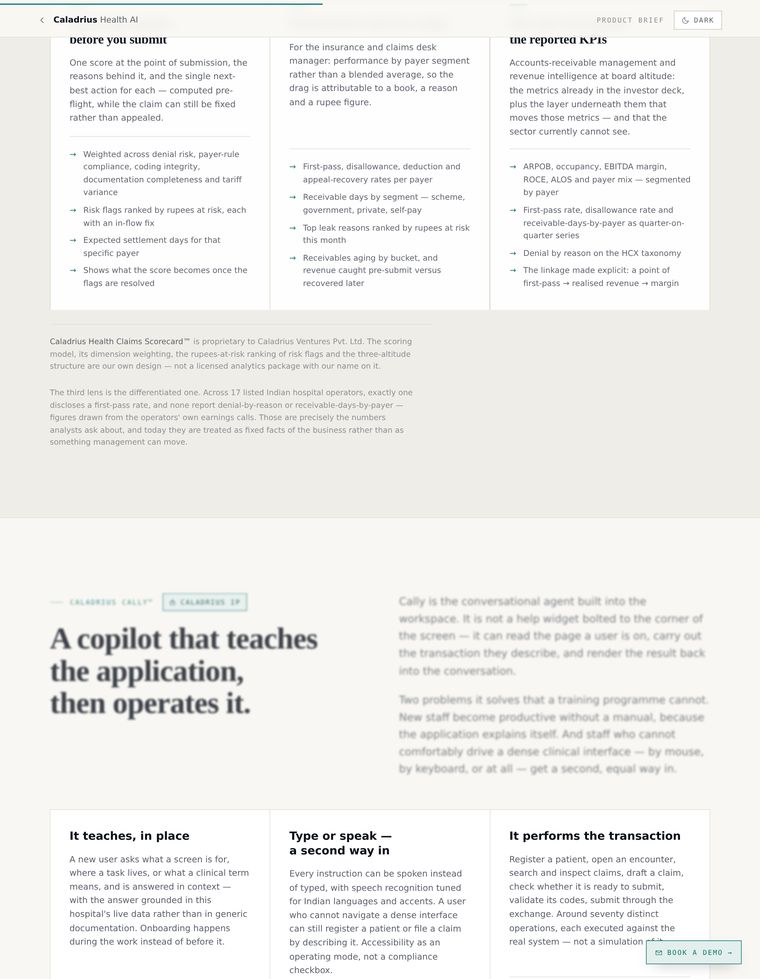
One score at the point of submission, the reasons behind it, and the single next-best action for each — computed pre-flight, while the claim can still be fixed rather than appealed.

  • Weighted across denial risk, payer-rule compliance, coding integrity, documentation completeness and tariff variance
  • Risk flags ranked by rupees at risk, each with an in-flow fix
  • Expected settlement days for that specific payer
  • Shows what the score becomes once the flags are resolved
02 The desk

Which book is the lever today

For the insurance and claims desk manager: performance by payer segment rather than a blended average, so the drag is attributable to a book, a reason and a rupee figure.

  • First-pass, disallowance, deduction and appeal-recovery rates per payer
  • Receivable days by segment — scheme, government, private, self-pay
  • Top leak reasons ranked by rupees at risk this month
  • Receivables aging by bucket, and revenue caught pre-submit versus recovered later
03 CFO & CEO

The mid-cycle behind the reported KPIs

Accounts-receivable management and revenue intelligence at board altitude: the metrics already in the investor deck, plus the layer underneath them that moves those metrics — and that the sector currently cannot see.

  • ARPOB, occupancy, EBITDA margin, ROCE, ALOS and payer mix — segmented by payer
  • First-pass rate, disallowance rate and receivable-days-by-payer as quarter-on-quarter series
  • Denial by reason on the HCX taxonomy
  • The linkage made explicit: a point of first-pass → realised revenue → margin

Caladrius Health Claims Scorecard™ is proprietary to Caladrius Ventures Pvt. Ltd. The scoring model, its dimension weighting, the rupees-at-risk ranking of risk flags and the three-altitude structure are our own design — not a licensed analytics package with our name on it.

The third lens is the differentiated one. Across 17 listed Indian hospital operators, exactly one discloses a first-pass rate, and none report denial-by-reason or receivable-days-by-payer — figures drawn from the operators' own earnings calls. Those are precisely the numbers analysts ask about, and today they are treated as fixed facts of the business rather than as something management can move.

Caladrius Cally™

Caladrius IP

A copilot that teaches the application, then operates it.

Cally is the conversational agent built into the workspace. It is not a help widget bolted to the corner of the screen — it can read the page a user is on, carry out the transaction they describe, and render the result back into the conversation.

Two problems it solves that a training programme cannot. New staff become productive without a manual, because the application explains itself. And staff who cannot comfortably drive a dense clinical interface — by mouse, by keyboard, or at all — get a second, equal way in.

It teaches, in place

A new user asks what a screen is for, where a task lives, or what a clinical term means, and is answered in context — with the answer grounded in this hospital's live data rather than in generic documentation. Onboarding happens during the work instead of before it.

  • Explains screens, terms and next steps
  • Answers from live data, never memory
  • Suggests what to do next

Type or speak — a second way in

Every instruction can be spoken instead of typed, with speech recognition tuned for Indian languages and accents. A user who cannot navigate a dense interface can still register a patient or file a claim by describing it. Accessibility as an operating mode, not a compliance checkbox.

  • Voice or text, same capability
  • Indian-language speech recognition
  • Audio is never stored

It performs the transaction

Register a patient, open an encounter, search and inspect claims, draft a claim, check whether it is ready to submit, validate its codes, submit through the exchange. Around seventy distinct operations, each executed against the real system — not a simulation of it.

  • Patients · encounters · claims · pre-auth
  • Documents summarised and searched
  • Results rendered as cards, in the chat

It builds the form you are missing

When a payer needs documentation the workspace has no form for, Cally generates a structured capture form on the spot — typed fields, coded answers, conditional logic that shows only what applies, and validation before submission. Templates can be saved and reused.

  • Generated on demand, then saved as a template
  • Conditional logic and constraint validation
  • Attached straight onto a claim or pre-auth

Complete documentation, fewer denials

Incomplete documentation is one of the largest single causes of denial. Because the generated forms are coded and validated at the point of capture, the evidence pack reaching the payer is complete the first time — turning a denial-and-appeal cycle into a submission that clears.

  • Captured against coded terminology
  • Checked before it reaches the payer
  • Exportable and attachable as evidence

A terminology expert on call

Look up a clinical concept, translate between coding systems, test whether one concept subsumes another, expand a hierarchy, retrieve drug information, or read a concept's terms in another Indian language — without leaving the claim being worked on.

  • SNOMED CT · ICD-10 · drug information
  • Translation, subsumption, hierarchy
  • Concept terms in multiple languages

What keeps it trustworthy is what it refuses to do. Cally never invents a patient, a claim number, a statistic or an identifier — if it does not have the data from a live lookup it says so and goes and fetches it. Before any action that writes, it states what it is about to do, lists the values it will use, and waits for explicit confirmation; silence is never treated as consent. It can only perform actions the signed-in user is themselves permitted to perform. And a filter sits between the workspace and the model, so identifiers such as mobile numbers, email addresses, ABHA numbers and Aadhaar are stripped before anything is sent — the assistant works with a name and a display ID, and nothing more.

How to read an AI claim in RCM

The question is not whether it uses AI. It is what happens when a step stalls.

A useful frame for evaluating anything in this category — ours included. Most tools marketed as AI-powered revenue cycle management sit at L2: they recommend, flag and suggest, while a human still makes every decision. Faster, same headcount. The industry's real difficulty is not reaching L3. It is that L3 automates tasks inside their own silos and multiplies the seams between them.

LevelStage & descriptionStatus
L1 Visibility

Dashboards, reports, analytics. Humans see what is happening. They still decide and act on everything.

Starting point
L2 Assistance

AI recommends, flags, suggests next best actions. Humans make every final decision. Faster — but same headcount.

Most orgs today
L3 Partial automation

Specific tasks automated end-to-end inside their own silo. Humans manage every handoff between automated systems. Seams multiply.

The plateau
L4 High automation

Workflows execute end-to-end across systems, sharing context. Humans handle genuine exceptions and judgment calls. Costs compress materially.

Realistic goal
L5 Fully autonomous

End-to-end autonomous execution. Continuous learning. Human oversight at the governance layer, not the workflow layer.

Long-term horizon

The distinction between L3 and L4 is not speed. It is whether the system can run a workflow end-to-end across systems — even when a step stalls — without routing back to a human. That is an architecture question, and it is decided long before the AI is chosen: shared context across steps, a common clinical data model, and somewhere for a genuine exception to go.

AI-native development

The product is AI-native. So is the process that builds it.

We build the way we expect the industry to build within a few years: work is specified as a complete feature, AI agents implement it against an encoded engineering standard, and every change arrives with its own tests, verification evidence and changelog entry in the same commit. It is why a team this size ships at this cadence.

It also creates a specific obligation. When machines write a meaningful share of the code in a system that holds patient data, the safeguards cannot be a review someone does afterwards, when there is time.

The same applies to the model's own output. AI behaviour is held to a registry of 99 application evals across five modules — performance, workflow, experience and safety — alongside 35 runtime evals, each persisted with pass/warn/fail history so a regression shows up as a number before it shows up as a denial. Past incidents become standing evals, so the same failure cannot return unnoticed.

Caladrius Health Vault™

Caladrius IP

The model never sees a patient.

Every AI feature in the platform runs on de-identified text. Before any call to an external model, protected health information is replaced with opaque tokens; the model's response is re-identified on the way back. No patient name, ABHA number, Aadhaar, date of birth, phone, email or address leaves your perimeter — and the reasoning quality is unaffected, because the model still sees a consistent entity. It just never learns who.

The Vault is our own privacy engine, built in-house. It is the single control point every flow of patient data passes through on its way to a log, an archive, an API response or a model.

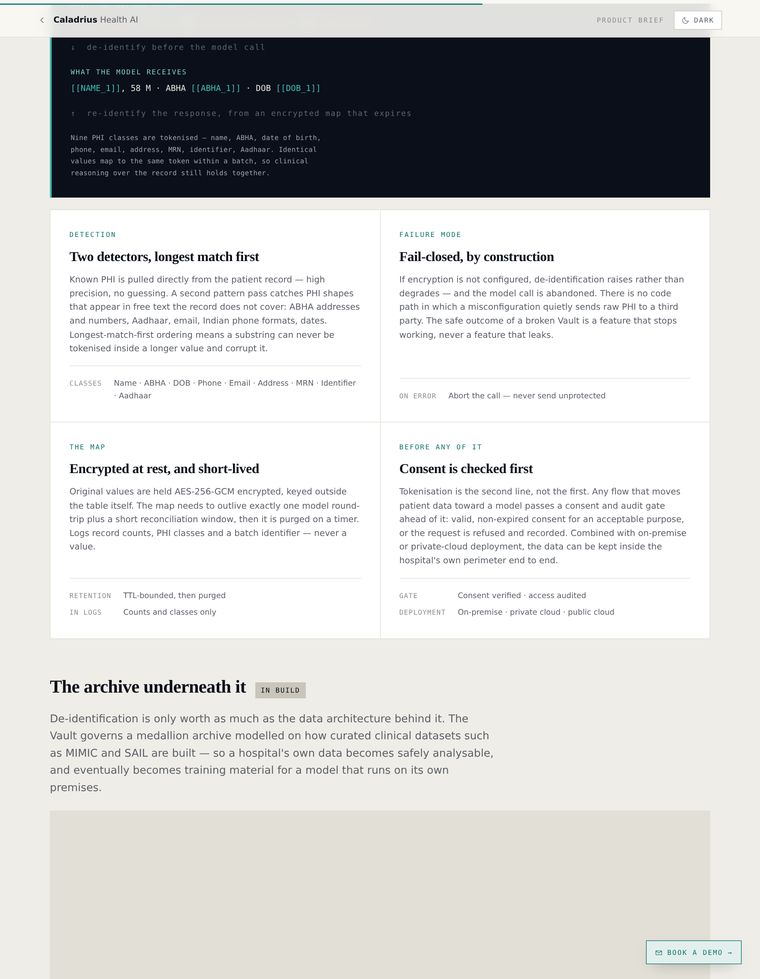
What the record holds Rajesh Kumar, 58 M · ABHA 12-3456-7890-1234 · DOB 1968-04-12
↓  de-identify before the model call
What the model receives [[NAME_1]], 58 M · ABHA [[ABHA_1]] · DOB [[DOB_1]]
↑  re-identify the response, from an encrypted map that expires

Nine PHI classes are tokenised — name, ABHA, date of birth, phone, email, address, MRN, identifier, Aadhaar. Identical values map to the same token within a batch, so clinical reasoning over the record still holds together.

Detection

Two detectors, longest match first

Known PHI is pulled directly from the patient record — high precision, no guessing. A second pattern pass catches PHI shapes that appear in free text the record does not cover: ABHA addresses and numbers, Aadhaar, email, Indian phone formats, dates. Longest-match-first ordering means a substring can never be tokenised inside a longer value and corrupt it.

Classes
Name · ABHA · DOB · Phone · Email · Address · MRN · Identifier · Aadhaar
Failure mode

Fail-closed, by construction

If encryption is not configured, de-identification raises rather than degrades — and the model call is abandoned. There is no code path in which a misconfiguration quietly sends raw PHI to a third party. The safe outcome of a broken Vault is a feature that stops working, never a feature that leaks.

On error
Abort the call — never send unprotected
The map

Encrypted at rest, and short-lived

Original values are held AES-256-GCM encrypted, keyed outside the table itself. The map needs to outlive exactly one model round-trip plus a short reconciliation window, then it is purged on a timer. Logs record counts, PHI classes and a batch identifier — never a value.

Retention
TTL-bounded, then purged
In logs
Counts and classes only
Before any of it

Consent is checked first

Tokenisation is the second line, not the first. Any flow that moves patient data toward a model passes a consent and audit gate ahead of it: valid, non-expired consent for an acceptable purpose, or the request is refused and recorded. Combined with on-premise or private-cloud deployment, the data can be kept inside the hospital's own perimeter end to end.

Gate
Consent verified · access audited
Deployment
On-premise · private cloud · public cloud

The archive underneath it

In build

De-identification is only worth as much as the data architecture behind it. The Vault governs a medallion archive modelled on how curated clinical datasets such as MIMIC and SAIL are built — so a hospital's own data becomes safely analysable, and eventually becomes training material for a model that runs on its own premises.

Bronze

Operational record

The live clinical and claims tables, exactly as the application writes them.

PHI present · in DPDPA scope
Application role, existing RBAC
Silver

Pseudonymised

FHIR-aligned, with every patient replaced by a stable anonymous linkage key so records still join truthfully.

Pseudonymised · in DPDPA scope
ETL and analytics roles only
Gold

Anonymised

Date-shifted per patient, age-banded, k-anonymised and aggregated under differential privacy.

Anonymised · out of DPDPA scope
Shareable for research and training
Vault plane

Identity, held apart

The identity and date-shift maps that make re-identification possible live in their own schemas — and the application cannot read them.

Direct identifiers · ETL role only
Revoked from the application role
HMAC-SHA256 linkage keys Per-patient date shift Age banding · 90+ k-anonymity · k=5 Differential privacy · ε=1.0 PHI scanner on model output Grant separation, tested

Why it matters commercially

In build

Once the Gold layer exists, a hospital can train localised models on its own de-identified corpus and progressively take over the work currently sent to third-party AI services — OCR, entity extraction, redaction. That is the end state the Vault is built toward: your data trains your model, on your hardware, and never leaves. The de-identification engine described above is live today; the archive and the on-premise model programme are in build.

Caladrius Health Vault™ is proprietary technology designed and built by Caladrius Ventures Pvt. Ltd. The de-identification engine, token map design, policy model and medallion governance scheme described here are our own work, developed for this platform. Nothing on this page is an off-the-shelf component.

Security by design

The standard is enforced while the code is written, not audited after.

This is a PHI codebase heading into ABDM M1/M2/M3 certification and a WASA penetration assessment, under DPDPA's 72-hour breach clock. Security is encoded as an artefact the tooling enforces — four layers, each independent of the one before it.

Layer 01 · Encoded

The standard is a file, not a wiki page nobody opens

A governing engineering standard sits in the repository and is loaded into every session: immutable prohibitions on hardcoded secrets and PHI exposure, an explicit instruction hierarchy that no ticket or code comment can override, and a prompt-injection protocol with a required disclosure format for anything suspicious found in a file or a tool response.

Covers
Secrets · PHI · injection · dependency provenance
Precedence
Wins over any issue spec or inline comment
Layer 02 · Enforced at write time

Guardrails in the harness, not in the prompt

Every single edit passes a blocking gate: a secret scan and a PHI-pattern scan run before the change is accepted. The eight most sensitive files — patient controllers, the ABDM health-information handler, the redaction and masking utilities — are locked unless the work is explicitly classified for them. Force-pushes to protected branches are refused at the shell.

Blocking
Gitleaks + PHI patterns, per edit
Scoped
PHI files gated by change classification
Layer 03 · Verified before merge

Deterministic scans and independent reviewers

Continuous integration runs secret detection, PII scanning, security linting, static analysis across JavaScript and Python, dependency audit and a CycloneDX SBOM on every change. Read-only auditor agents review against WASA criteria, ABDM compliance and general code quality — tiered so the most sensitive changes draw all three.

Supply chain
SHA-pinned actions · Dependabot · SBOM
Promotion
dev → staging → QA, scanned at each gate
Layer 04 · Built for the assessment

Controls the certification will actually test

All database access is parameterised and machine-checked — a guard rejects any query built by string interpolation, so SQL injection is closed structurally rather than by discipline. Consent is verified before health information is read. ABHA identifiers are masked to the last four digits in every interface and every log line. Patient data access writes an audit entry, and data stays resident in India under DPDPA.

Baseline
OWASP Top 10 · ASVS as floor, not ceiling
Data
AES-256 at rest · TLS 1.2+ in transit

Certification status is honest: ABDM M1/M2/M3 and WASA are in progress, not complete. We will show you the current state of each against its test suite rather than a badge.

The Caladrius harness

Caladrius IP

Six of the seven components are yours to build. One makes the press release.

A working test for any AI vendor, including this one: what do they own that you could not rebuild with a corporate card and a long weekend? The model layer is now a commodity — capable, cheap and interchangeable. Everything above it is the actual system, and in a regulated Indian hospital every layer of it is load-bearing. Here is the stack, and where we sit on each layer.

Those six layers above the model are what we call the Caladrius Health AI Studio harness for revenue intelligence — the part we built, and the part that does not change when the model underneath it does.

7 Human oversight + monitoring99 application evals across five modules and 35 runtime evals, persisted with pass/warn/fail history and surfaced in an ops console. Every pipeline step is inspectable before submission. Built
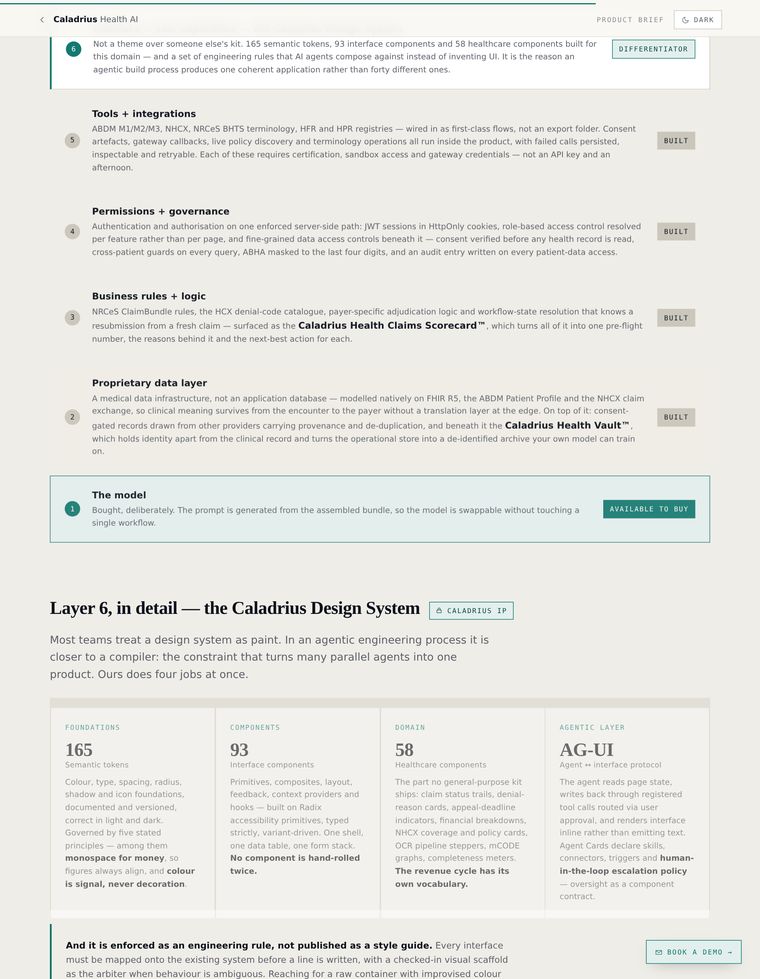
6 Interface + user experience — the Caladrius Design SystemNot a theme over someone else's kit. 165 semantic tokens, 93 interface components and 58 healthcare components built for this domain — and a set of engineering rules that AI agents compose against instead of inventing UI. It is the reason an agentic build process produces one coherent application rather than forty different ones. Differentiator
5 Tools + integrationsABDM M1/M2/M3, NHCX, NRCeS BHTS terminology, HFR and HPR registries — wired in as first-class flows, not an export folder. Consent artefacts, gateway callbacks, live policy discovery and terminology operations all run inside the product, with failed calls persisted, inspectable and retryable. Each of these requires certification, sandbox access and gateway credentials — not an API key and an afternoon. Built
4 Permissions + governanceAuthentication and authorisation on one enforced server-side path: JWT sessions in HttpOnly cookies, role-based access control resolved per feature rather than per page, and fine-grained data access controls beneath it — consent verified before any health record is read, cross-patient guards on every query, ABHA masked to the last four digits, and an audit entry written on every patient-data access. Built
3 Business rules + logicNRCeS ClaimBundle rules, the HCX denial-code catalogue, payer-specific adjudication logic and workflow-state resolution that knows a resubmission from a fresh claim — surfaced as the Caladrius Health Claims Scorecard™, which turns all of it into one pre-flight number, the reasons behind it and the next-best action for each. Built
2 Proprietary data layerA medical data infrastructure, not an application database — modelled natively on FHIR R5, the ABDM Patient Profile and the NHCX claim exchange, so clinical meaning survives from the encounter to the payer without a translation layer at the edge. On top of it: consent-gated records drawn from other providers carrying provenance and de-duplication, and beneath it the Caladrius Health Vault™, which holds identity apart from the clinical record and turns the operational store into a de-identified archive your own model can train on. Built
1 The modelBought, deliberately. The prompt is generated from the assembled bundle, so the model is swappable without touching a single workflow. Available to buy

Layer 6, in detail — the Caladrius Design System

Caladrius IP

Most teams treat a design system as paint. In an agentic engineering process it is closer to a compiler: the constraint that turns many parallel agents into one product. Ours does four jobs at once.

Foundations 165Semantic tokens

Colour, type, spacing, radius, shadow and icon foundations, documented and versioned, correct in light and dark. Governed by five stated principles — among them monospace for money, so figures always align, and colour is signal, never decoration.

Components 93Interface components

Primitives, composites, layout, feedback, context providers and hooks — built on Radix accessibility primitives, typed strictly, variant-driven. One shell, one data table, one form stack. No component is hand-rolled twice.

Domain 58Healthcare components

The part no general-purpose kit ships: claim status trails, denial-reason cards, appeal-deadline indicators, financial breakdowns, NHCX coverage and policy cards, OCR pipeline steppers, mCODE graphs, completeness meters. The revenue cycle has its own vocabulary.

Agentic layer AG-UIAgent ↔ interface protocol

The agent reads page state, writes back through registered tool calls routed via user approval, and renders interface inline rather than emitting text. Agent Cards declare skills, connectors, triggers and human-in-the-loop escalation policy — oversight as a component contract.

And it is enforced as an engineering rule, not published as a style guide. Every interface must be mapped onto the existing system before a line is written, with a checked-in visual scaffold as the arbiter when behaviour is ambiguous. Reaching for a raw container with improvised colour instead of the system's card is treated as drift and rejected. That constraint is what makes an agentic process viable at all — it is also why "role-aware by default" is a component contract here rather than a design intention: the same claim record renders differently for a biller, an insurance desk, a CFO and a CEO, because the components take role as an input.

The model is the part anyone can buy. Layers 2 through 7 — the harness — are the part we built.

The Caladrius Health AI Studio harness for revenue intelligence, together with the Caladrius Health Vault™ and the Caladrius Health Claims Scorecard™, is proprietary technology of Caladrius Ventures Pvt. Ltd. The model layer is licensed from third-party providers and is deliberately interchangeable.

The harness, layer by layer

Seven layers. Six of them ours.

The same seven components, taken one at a time. Scroll the stack — each layer settles onto the one beneath it, in the order they actually depend on each other, from human oversight at the top down to the interchangeable model at the base.

07

Human oversight + monitoring

99 application evals across five modules and 35 runtime evals, persisted with pass, warn and fail history and surfaced in an ops console. Every pipeline step is inspectable before submission.

Built
06

Interface + user experience — the Caladrius Design System

Not a theme over someone else's kit. 165 semantic tokens, 93 interface components and 58 healthcare components built for this domain, enforced as an engineering rule rather than published as a style guide.

Differentiator
05

Tools + integrations

ABDM M1/M2/M3, NHCX, NRCeS BHTS terminology, and the HFR and HPR registries — wired in as first-class flows rather than an export folder. Consent artefacts and gateway callbacks are part of the workflow.

Built
04

Permissions + governance

Authentication and authorisation on one enforced server-side path: JWT sessions in HttpOnly cookies, role-based access control resolved per feature rather than per page, and consent verified before any health record is read.

Built
03

Business rules + logic

NRCeS ClaimBundle rules, the HCX denial-code catalogue, payer-specific adjudication logic and workflow-state resolution that knows a resubmission from a fresh claim — surfaced as the Claims Scorecard.

Built
02

Proprietary data layer

A medical data infrastructure, not an application database — modelled natively on FHIR R5, the ABDM Patient Profile and the NHCX claim exchange, so clinical meaning survives from the encounter to the payer.

Built
01

The model

Bought, deliberately. The prompt is generated from the assembled bundle, so the model is swappable without touching a single workflow.

Available to buy

Where this goes next

We are looking for a small number of the right partners.

The platform is real and deployed. What compounds it now is depth in specific settings — and there is more value in a handful of serious collaborations than in a wide, shallow launch.

Providers

Design partners

Hospitals and diagnostic networks willing to run a real claim line with us and be blunt about where it breaks. You get the roadmap shaped around your denial patterns; we get the ground truth no synthetic dataset provides.

Payers & TPAs

The other side of the exchange

NHCX only compresses cycle time if both ends are clean. We want counterparties to test submission quality against — and to co-define what a first-pass-worthy bundle actually looks like.

Ecosystem

ABDM & NHCX builders

HMIS and EMR vendors, ABDM integrators, terminology and identity providers. Standards-native means we would rather interoperate with you than rebuild what you already do well.

Research

Applied AI & evaluation

Clinical coding accuracy, grounded generation, and evaluation methodology for AI in regulated healthcare settings. We have the benchmarks and the real workflow to test against.

Next step

See it run against a real claim.

A working session, not a slide walkthrough: we take an encounter end to end — record pull, bundle assembly, pre-authorisation, payer response — and you interrogate every step. Roughly 45 minutes.