
When we last left Meera, she walked out of a Chennai hospital carrying a question she couldn’t shake. A routine check-up had turned into an afternoon at the insurance helpdesk, helping an old colleague whose father was facing a planned surgery. Along the way she had used her ABHA (Ayushman Bharat Health Account, the free 14-digit health ID that more than 90 crore Indians now hold) to breeze through her own registration [1]. Beyond the operation itself, another set of questions pressed on the family: would the insurer approve the claim, how much would they pay themselves, and how long would the whole thing take?
A few weeks later, her phone answered that last part. It was the same colleague, messaging from a hospital corridor. His father’s surgery had gone well, and the doctor had cleared him for discharge. Yet the family was still there, bags packed, watching the billing desk. The hold-up wasn’t medical. It was a set of messages travelling back and forth between the hospital and the insurer, and until that exchange resolved, the family waited to leave. “Why is this taking so long?” he asked.
It is the part of healthcare that happens out of sight: the claim. Meera had learned enough to explain it, and the honest answer has two halves: why the wait happens today, and why it is beginning to shorten.
What is happening while you wait
When you opt for cashless treatment, where the insurer pays the hospital directly, instead of you paying first and claiming the money back later, a quiet review begins behind the counter.
Before a planned procedure, the hospital sends the insurer a pre-authorisation request. In plain terms, it says: here is the patient, here is the diagnosis, here is the estimated cost: do you approve? The insurer, or the Third Party Administrator (TPA) that processes claims on its behalf, checks the policy, the documents and the medical details, then replies with an approval, a query, or a request for more papers. At discharge, the final bill runs through the same loop a second time so the insurer can confirm what it will pay.
Each step sounds straightforward. The waiting comes from how those steps are carried out in practice.
Why it takes time today
For years, much of this exchange has been semi-manual and non-standard [3]. Different insurers and TPAs have used different portals, different forms and different formats, so hospital desks often re-key the same information in several places and trade scanned documents by email or upload. When a detail is missing a diagnosis code, a signature, an investigation report, the request bounces back, and the clock restarts.
There is a second reason a family might wait, one many patients only discover at the counter. Cashless has traditionally worked only at hospitals inside the insurer’s network. Walk into a hospital your insurer hasn’t tied up with, and you may fall to the slower reimbursement route: pay the full bill yourself, then file for the money afterwards. As of early 2024, the General Insurance Council noted that only about 63% of customers were using cashless, with the rest left to claim reimbursements, often because they were admitted outside the network [2]. Those reimbursement files can take far longer to close: industry assessments put typical reimbursement processing at roughly 30 days, extending toward 45 days when additional verification is needed [3].
None of this reflects a single party at fault. It is the residue of a system that grew one insurer, one hospital and one portal at a time, efficient in pieces, slow as a whole.
What has already changed
The waiting room of 2026 is not the one of a few years ago. Two shifts stand out.
First, the regulator set a clock. In its May 2024 Master Circular on health insurance, the Insurance Regulatory and Development Authority of India (IRDAI) told insurers to decide cashless pre-authorisation within one hour of the request and to clear final discharge approval within three hours, with a safeguard for patients built in: if that window is missed, the resulting extra hospital charges are not passed on to the family [4]. Early results suggest the benchmark is largely holding: for cases between August 2024 and May 2025, insurers cleared about 86.9% of pre-authorisations within the hour and roughly 96.7% of discharge approvals within three hours [5].
Second, the industry widened the door. The “Cashless Everywhere” initiative, launched by the General Insurance Council in January 2024, is designed to let policyholders use cashless treatment at any eligible hospital, including those outside the insurer’s network, subject to intimation and admissibility, rather than defaulting to reimbursement [2]. For a patient, that is the difference between leaving with a settled bill and leaving with a stack of receipts to chase.
What NHCX is built to change next
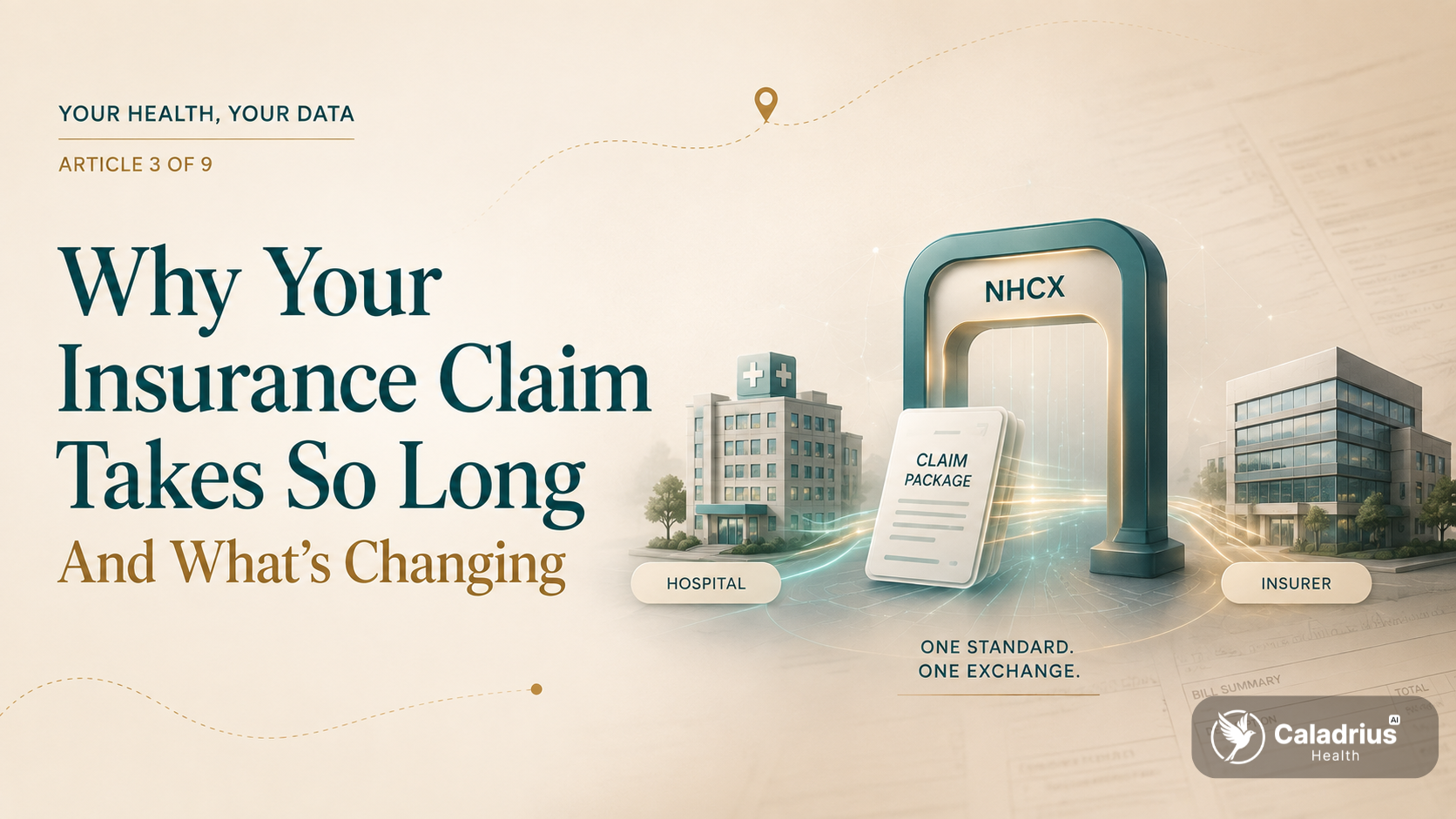
The deeper change targets the exchange itself. The National Health Claims Exchange (NHCX), a shared, standardised digital gateway for insurance claims, built on the ABDM (Ayushman Bharat Digital Mission) foundation and overseen by the National Health Authority went live in 2024, with its first live claims processed in early July 2024 [6].
Think of NHCX less as a new portal and more as a common language. Instead of every hospital and insurer speaking its own dialect through separate systems, a claim is packaged in one standard format and passed through a single exchange any participant can read. When the information arrives complete and correctly coded, far less has to be re-entered or sent back, where much of the waiting-room wait disappears. Policy analysts note that where claims today may take weeks to settle, fully and accurately coded claims moving through these rails could potentially be settled in about 48 hours [3].
For the family in that corridor, the promise is not a slogan. It is a shorter loop: fewer forms retyped at the desk, fewer documents lost between inboxes, and a discharge that hinges on a data exchange rather than an afternoon of paperwork.
What this means for you at the counter
None of this asks patients to master the back office, but a few habits help. Before a planned admission, link your ABHA so your records are easy to pull and keep your policy details to hand, and ask the hospital to raise pre-authorisation early; an advance request gives the insurer more time to respond. And know the clock now runs in your favour: under IRDAI’s 2024 Master Circular, the one-hour and three-hour benchmarks are your entitlement, not a courtesy [4].
The approval came through later that day, and the family finally went home. The wait had still taken its hours, but this time they hadn’t spent it in the dark, because someone had helped them understand what was happening. And the machinery behind that wait is being rebuilt quietly, standard by standard and rule by rule, so that the next family by a packed bag waits a little less, and understands a little more of why.
This is Article 3 in the “Your Health, Your Data” series from CaladriusHealth.AI, a nine-part guide to India’s digital health ecosystem. The series covers ABHA, health data consent, claims and cashless hospitalisation, switching hospitals, and the rights patients carry into every clinical encounter.
Sources
- “Ayushman Bharat Digital Mission Crosses Landmark Milestone of 90 Crore ABHA Accounts”: Press Information Bureau, Government of India (30 May 2026). https://www.pib.gov.in/PressReleasePage.aspx?PRID=2266979®=3&lang=1
- “Launch of Cashless Everywhere”: General Insurance Council press release (24 January 2024). https://www.gicouncil.in/news-media/events/press-release-launch-of-cashless-everywhere/
- NATHEALTH: “National Health Claims Exchange” policy paper, June 2025 (current reimbursement processing of ~30 days, extending toward ~45 days with added verification; potential ~48-hour settlement for fully and accurately coded claims). https://nathealthindia.org/wp-content/uploads/2025/06/National-Health-Claims-Exchange_Latest.pdf
- “Indian insurance regulator mandates three-hour cashless claim approval”: Life Insurance International, on the IRDAI Master Circular on Health Insurance (May 2024; one-hour pre-authorisation, three-hour discharge, effective 31 July 2024). https://www.lifeinsuranceinternational.com/news/irdai-cashless-claim-approval/
- “Cashless Health Insurance Claim Authorisation in 2025: IRDAI’s New Rules and Data”: Angel One, citing IRDAI compliance data (Aug 2024–May 2025: 86.88% of pre-authorisations within 1 hour; 96.69% of discharge approvals within 3 hours). https://www.angelone.in/news/personal-finance/cashless-health-insurance-claim-authorisation-in-2025-how-long-does-it-take-irdai-s-new-rules-and-data
- “HDFC ERGO General Insurance processes its first claim on NHCX platform”: Business Standard (9 July 2024), on the first live claim processed through the National Health Claims Exchange (built on ABDM, overseen by the National Health Authority). https://www.business-standard.com/finance/insurance/hdfc-ergo-general-insurance-processes-its-first-claim-on-nhcx-platform-124070900692_1.html
- Company confirmation: HDFC ERGO newsroom. https://www.hdfcergo.com/news/health-insurance/hdfc-ergo-general-insurance-processes-it-s-first-health-claim-through-the-national-health-claims-exchange-platform