
ABHA registration at the front desk
Create, search and verify an ABHA via Aadhaar or mobile, or scan the patient's ABHA card QR straight into registration.
- Create, search and verify
- ABHA card QR scan
- ABHA masked to the last 4 digits everywhere

An AI-native revenue intelligence application that works the hospital revenue cycle end to end, directly on ABDM and NHCX. Identity, records, claims and money in one workspace.
One connected suite. The PHR App is for the patient, AI Studio runs care and claims on desktop and iPad, and AR Studio turns each claim into collected revenue. Cally is the AI copilot in every product.
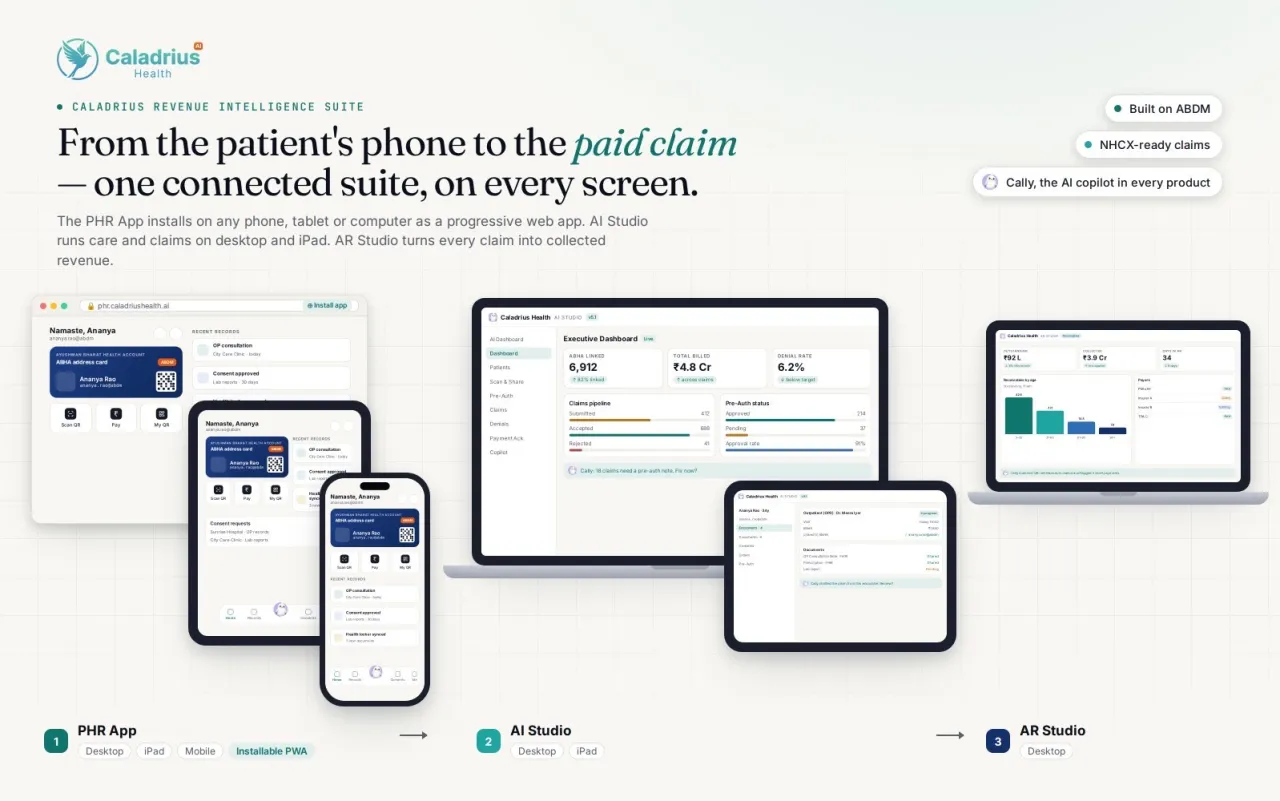
Not a dashboard over a manual process. The workflow, the clinical data model and the AI were designed together.
Coverage found by live policy discovery against the payer.
Requests assembled from the encounter and sent over NHCX.
A complete ClaimBundle, checked and scored before it is sent.
Each denial resolved against its code and the document requested.
Payments matched to claims, with receivables visible by payer.
One workspace across patient identity, clinical records, claims and money.
Create, search and verify an ABHA via Aadhaar or mobile, or scan the patient's ABHA card QR straight into registration.
Pull a patient's records from any ABDM-linked provider with consent, and publish your own back to the network. Both HIU and HIP.
A ten-step journey from patient preparation to payer response. The ClaimBundle is assembled from the encounter, not from a form somebody retyped.
Upload to submission in one inspectable pipeline: OCR, clinical entity extraction, FHIR bundle assembly and preview. Multi-file, with per-file state.
Live integration with the NRCeS Bharat Health Terminology Service for SNOMED CT lookup and ICD-10 translation, so coded meaning reaches the payer intact.
A front-desk clerk, a coder, a claims manager and a CFO each get their own screen. Alerts fire the moment a record pull fails or a claim changes state.
The same claim data answers a different question for the operator, the desk manager and the board. All three ship out of the box, with no separate BI project.
One score at the point of submission, the reasons behind it, and the next best action for each.
Performance by payer segment rather than a blended average.
Accounts receivable and revenue intelligence at board level.
Cally is the conversational agent built into the workspace. It reads the page a user is on, carries out the task they describe, and shows the result in the conversation.
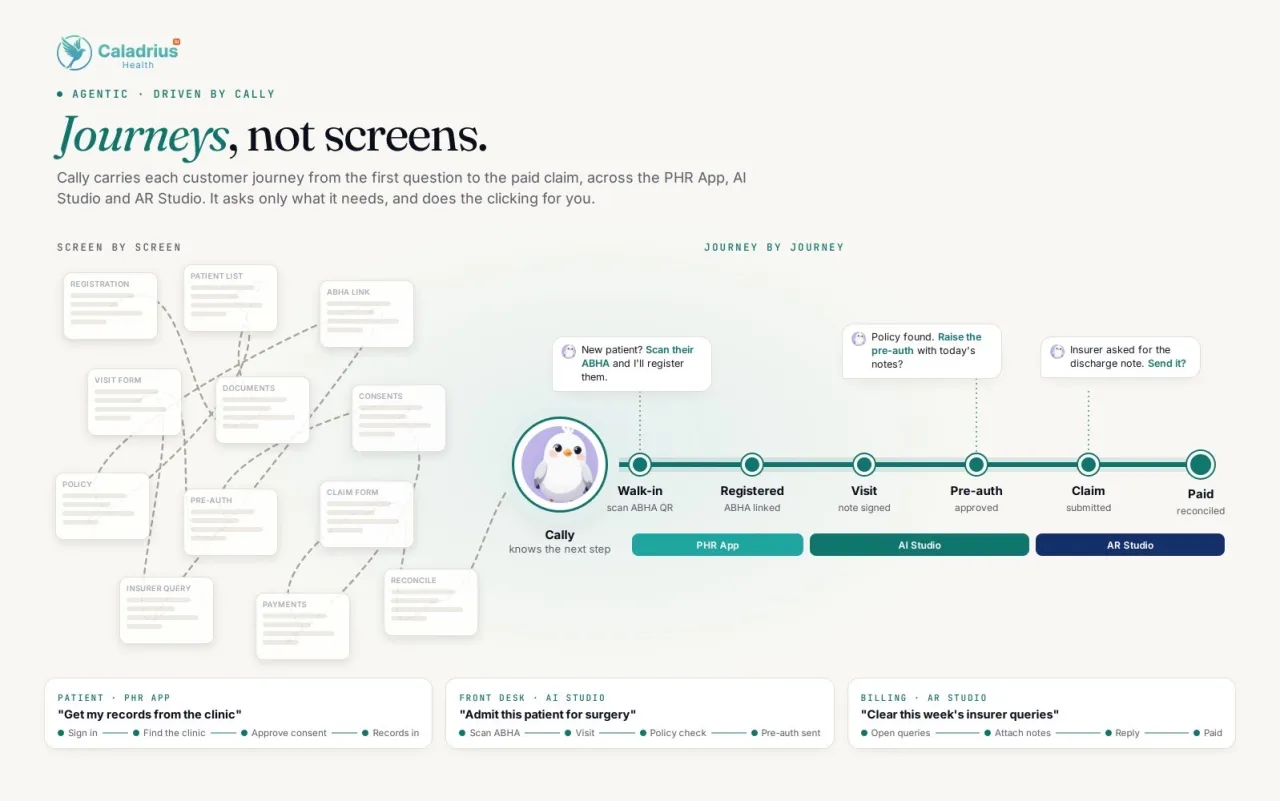
New staff ask what a screen is for, where a task lives or what a term means, and get an answer in context.
Every instruction can be spoken instead of typed, with speech recognition tuned for Indian languages and accents.
Register a patient, open an encounter, draft a claim, validate its codes and submit it. Around seventy operations, run against the real system.
When a payer needs documentation the workspace has no form for, Cally generates a structured capture form on the spot.
Look up a clinical concept, translate between coding systems or retrieve drug information without leaving the claim.
Before any action that writes, Cally states what it will do and the values it will use, then waits for explicit confirmation.
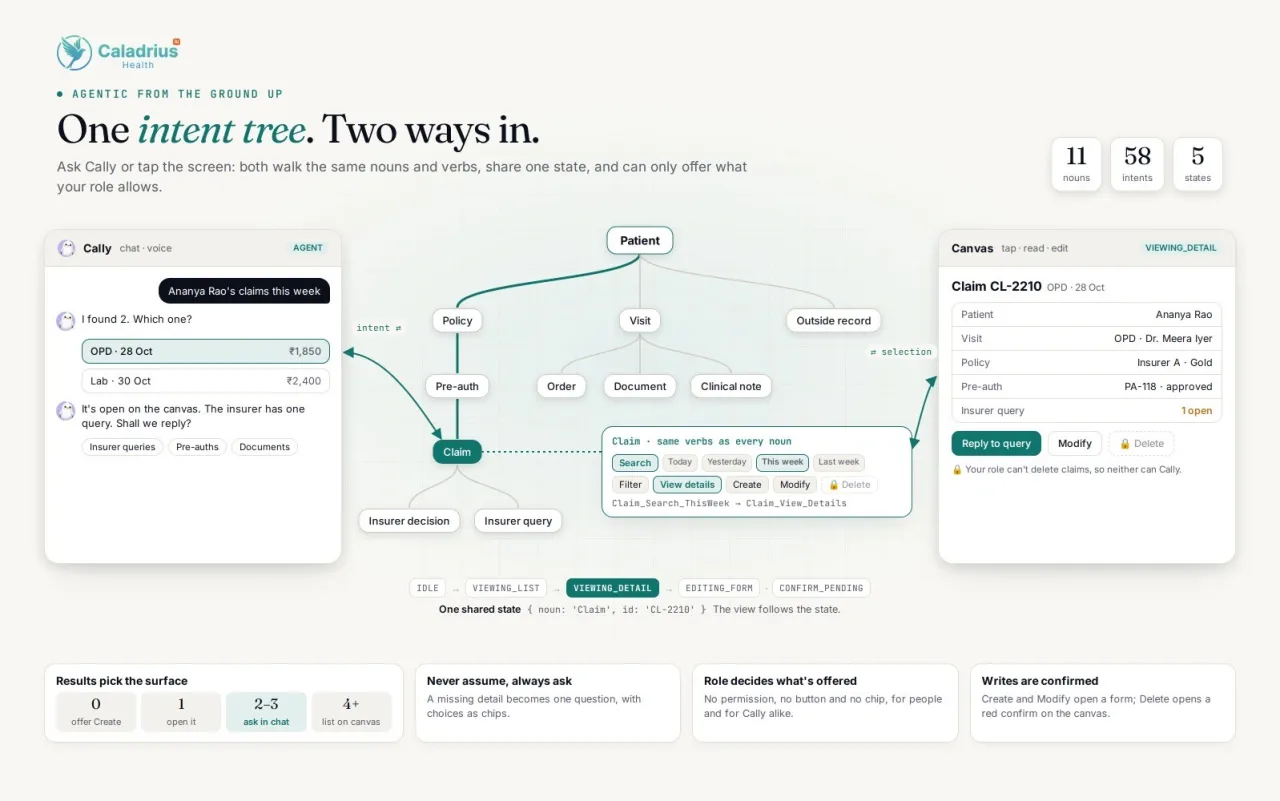
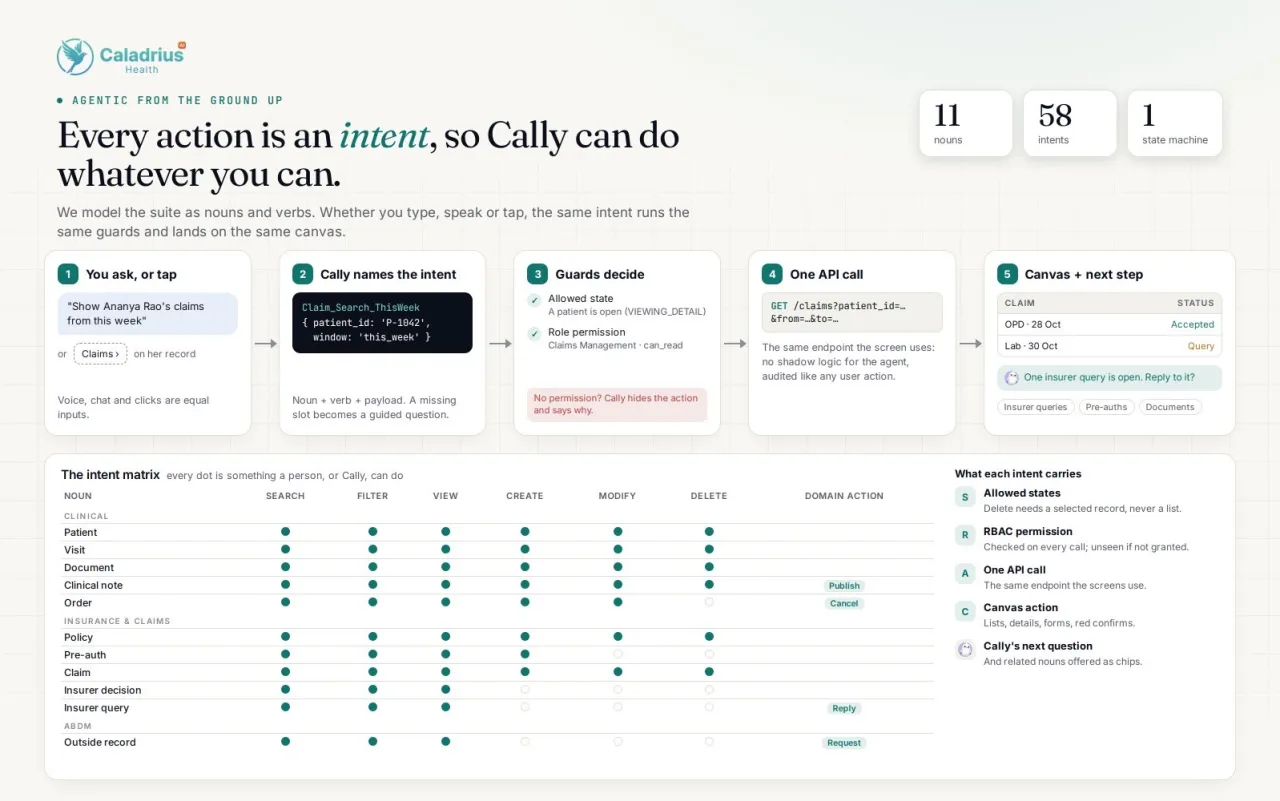
The suite is modelled as nouns and verbs. Whether you type, speak or tap, the same intent runs the same checks and lands on the same screen.
Every AI feature runs on de-identified text. The Caladrius Health Vault™ is the control point every flow of patient data passes through.
Protected health information is replaced with opaque tokens before a call to an external model, and restored in the response.
Consent is verified before any health record is read, and every access to patient data writes an audit entry.
The data layer is modelled natively on FHIR R5 and the ABDM Patient Profile. Claims move as NHCX ClaimBundles. Records move under ABDM consent artefacts.
Delivered in the environment your hospital requires, and provisioned and set up for you by our team.
Validated in real time while the claim is assembled, not at adjudication.
Against 70–75% first-pass accuracy in traditional RCM.
Automated end to end, at any volume, without adding headcount.
Live dashboards and alerts that fire while a problem is still fixable.
These are design targets, benchmarked against the status quo. They are not results reported by a customer.
A working session of roughly 45 minutes: we take an encounter end to end and you question every step.
Forward-looking statements. This page describes Caladrius Health AI Studio and the wider platform, and includes forward-looking statements about capabilities, targets and certifications that are planned or in progress. They are not a commitment or a guarantee, and may change. Product screens shown are illustrative. For the current status of each capability, see the product brief.
It is an AI-native revenue intelligence application for hospitals. It works the revenue cycle end to end: eligibility, pre-authorisation, claim submission, denial management and reconciliation, directly on ABDM and NHCX.
Front-desk staff, coders, claims and insurance desk managers, and finance leaders. Each role gets its own view and KPIs, resolved by role rather than one shared dashboard.
No patient identity does. Before any call to an external model, the Caladrius Health Vault replaces protected health information with opaque tokens, and the response is re-identified on the way back. If the Vault is not configured correctly, the call is abandoned rather than sent unprotected.
Not yet. ABDM M1/M2/M3, NHCX and WASA milestones are in progress. We will show you the current state of each rather than a badge.
It is cloud-agnostic. It can be delivered on-premise, in a private cloud or in a public cloud.
Register your interest on the pricing page. Our team contacts you, and once terms are agreed we provision AI Studio for your hospital.